Minister for Finance and Revenue Senator Muhammad Aurangzeb on Saturday said Pakistan’s economy continued to show signs of recovery despite ongoing regional tensions, citing strong growth in large-scale manufacturing, exports, remittances and foreign investment inflows.
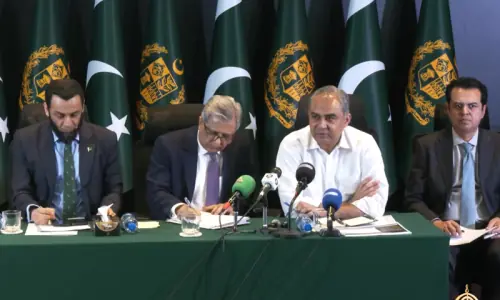
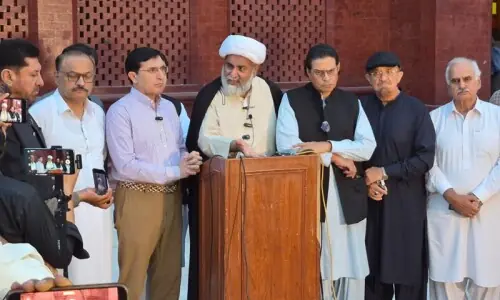
Addressing a news conference alongside Minister for Petroleum Ali Pervaiz Malik, the finance minister said the country’s large-scale manufacturing (LSM) sector recorded 11 per cent year-on-year growth in April, while cumulative growth during the first nine months of the current fiscal year stood at 6.5pc.
He said the government expected the GDP growth rate to remain close to 4pc during the current fiscal year, compared to 3.1pc last year.
Exports have grown by 9pc month-on-month and 14pc year-on-year, driven by value-added textiles, IT and other sectors, he said, adding that the export growth was broad-based.
Highlighting overseas inflows, Aurangzeb said remittances reached $3.5 billion in April after touching $3.8bn in March during Ramazan, describing the sustained inflows as a strong vote of confidence from overseas Pakistanis.
The finance czar added that inflows under the Roshan Digital Account (RDA) also rose sharply to $320 million in April, the highest monthly volume in the scheme’s history.
“This is an investment-led discussion. Overseas Pakistanis are investing in New Pakistan Certificates, real estate and the stock market,” he remarked.
The minister further said Pakistan had re-entered international capital markets after four years and recently raised $750 million through a Eurobond issuance despite the ongoing regional conflict.
He added that Pakistan was set to access Chinese capital markets for the first time through a Panda Bond next week. “Next week you will hear good news that, for the first time, we will be accessing Chinese capital markets through a Panda Bond,” he said.
The finance minister further said the country’s foreign exchange reserves were projected to reach a level equivalent to around three months of import cover by the end of June.
He also said macroeconomic stability was intended to ensure industrial continuity, facilitate the opening of letters of credit and the repatriation of profits and dividends, and generate employment opportunities.
Commending the Petroleum Ministry for maintaining uninterrupted fuel supplies over the past two months, the finance minister said no shortages or supply chain disruptions had occurred in the country despite challenges across the region.
“There have been shortages and long queues in different countries, but nothing of that sort happened in Pakistan,” he said, appreciating the efforts of the petroleum minister and his team.
Referring to recent fuel price adjustments, Aurangzeb said the government had continued targeted subsidies for vulnerable segments, including motorcyclists, public transport users and small farmers, in consultation with provincial governments.
He said the subsidies had now been extended into the third month at the direction of the prime minister and chief ministers to provide relief to weaker sections of society.
The finance minister, however, cautioned that Pakistan’s oil import bill had increased by over $1 billion between March and April, urging the public to exercise restraint in energy consumption to protect the external account position.
“Our external account is equally important. We all need to be careful in our consumption patterns,” he said.
Aurangzeb said Pakistan remained committed to fulfilling all international financial obligations with bilateral and multilateral partners as a responsible country.
He also expressed hope that the regional conflict would end soon, warning that damage to regional energy infrastructure could take months to recover even after hostilities ceased.
“We are monitoring the possible impact on inflation, GDP growth, remittances and exports because hope alone is not a strategy,” he remarked.