US, India, Australia and Japan meet to deepen bulwark against China
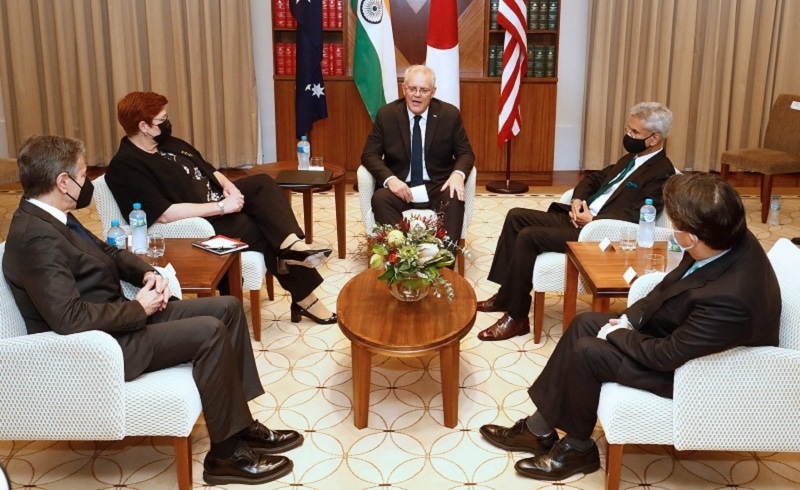

The top diplomats of the United States, Australia, Japan and India opened talks in Melbourne Friday on deepening their Quad alliance, hoping to blunt China's expanding power across the Asia-Pacific region.
Australian Prime Minister Scott Morrison kicked off the day by highlighting the group's importance in building cooperation among democracies while making a thinly-veiled allusion to his country's troubled relationship with Beijing.
“We live in a very fragile, fragmented and contested world,” he told the visiting officials. “We stand up to those who would seek to coerce us,” he said.
Without mentioning China by name, Morrison said it was a “great comfort” that the three fellow Quad members understand “the coercion and the pressure that Australia has been placed under”.
US Secretary of State Antony Blinken said that even though Russia's threat to Ukraine occupies Washington right now, the longer-term issue is China's rising power.
“To my mind, there's little doubt that China's ambition over time is to be the leading military, economic, diplomatic and political power not just in the region but in the world,” he told The Australian newspaper on the eve of the talks.
Also read: In message to China, Biden to meet Australia, India, Japan PMs
Tech, health, climate
The Quad was first launched in 2007 but only took root a decade later after China aggressively projected its military power into the South China Sea, and following violent border clashes with India.
While the four held joint naval exercises in 2020 in the Bay of Bengal, the meetings in Melbourne are aimed at deepening cooperation across other fields like fighting Covid-19 and coordinating on critical information technology issues, including the global rollout of 5G telecommunications networks.
Blinken said they were seeking to develop an “affirmative vision” on a range of challenges, such as agreeing on technology standards and cooperating on health issues and climate change.
The Covid-19 pandemic has been central to giving the grouping greater meaning beyond its image of trying to “contain” China.
The four countries used the Quad framework to commit to distributing 1.3 billion vaccine doses, with more than 500 million already delivered, according to Payne.
As for Washington, the meeting is a chance to reaffirm its decision to make Asia and the Pacific the centrepiece of foreign and defence policy, even as the White House and Pentagon are currently consumed by the potential for a Russian invasion of Ukraine.
While Ukraine is “front and centre” in Washington right now, Blinken said ahead of his arrival in Australia: “The world is a big place.”
“Our interests are global and you all know very well the focus that we put on the Asia-Pacific and the Indo-Pacific regions,” he said.