MOSCOW: Russia rolled its tanks across Belarus on Thursday for live-fire drills that drew an ominous warning from Nato and added urgency to Western efforts to avert a feared invasion of Ukraine.
Nato said Russia’s deployment of missiles, heavy armour and machine-gun toting soldiers marked a “dangerous moment” for Europe some three decades after the Soviet Union’s collapse.
The war games — set to run until February 20 — followed a gradual Russian military buildup around Ukraine that some US estimates say has reached 130,000 soldiers grouped in dozens of combat brigades.
Western leaders have been shuttling to Moscow in an effort to keep the lines of communication open, giving Russia a chance to air its grievances about Nato’s expansion into eastern Europe and ex-Soviet states.
British Foreign Secretary Liz Truss took a tough message to Moscow on Thursday, accusing Russia of adopting a “threatening posture” and urging the Kremlin to withdraw its forces to prove it had no plans to mount an attack.
Kiev denounced the war games as “psychological pressure” while French Foreign Minister Jean-Yves Le Drian called the exercises “a very violent gesture”. Russia has also sent six warship through the Bosphorus for naval drills on the Black Sea and the neighbouring Sea of Azov.
Kiev condemned their presence as an “unprecedented” attempt to cut off Ukraine from both seas. Moscow and Minsk have not disclosed how many troops are participating, but the United States has said around 30,000 soldiers were being dispatched to Belarus from locations including Russia’s Far East.
Russia’s defence ministry said the exercises would centre around “suppressing and repelling external aggression”. The Kremlin has insisted that the troops will go home after the exercises.
But Ukraine’s President Volodymyr Zelensky said “the accumulation of forces at the border is psychological pressure from our neighbours”.
Kiev has launched its own military drills expected to mirror Russia’s games, but officials have said little about them out of apparent fear of escalating tensions.
“All the (Russian) talk about some mythical threat from Nato or Ukraine is nonsense,” Ukrainian Foreign Minster Dmytro Kuleba said.
Russia is trying to secure written guarantees that Nato will withdraw its presence from eastern Europe and never expand into Ukraine. The United States and Nato have officially rejected Russia’s demands.
But Washington has floated the idea of the sides striking a new disarmament agreement for Europe — an offer viewed as useful but dramatically insufficient by Moscow. Truss was the latest Western diplomat to travel to Moscow, where she reported receiving promises from her Russian counterpart Sergei Lavrov that the Kremlin had no plans to invade Ukraine. “We need to see those words followed up by actions,” she told reporters after the talks. But Lavrov said he was “disappointed” by the talks.
He said the drills in Belarus as well as the movement of troops across Russia’s own territory had spurred “incomprehensible alarm and quite strong emotions from our British counterparts and other Western representatives”.
Moscow’s chilly relations with London nearly ruptured after the 2018 poisoning of former Russian double agent Sergei Skripal and his daughter in England, which the UK blamed on the Kremlin.
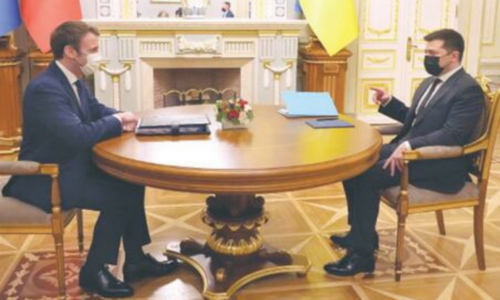
Truss’s trip came just days after French President Emmanuel Macron conducted a round of shuttle diplomacy between Moscow and Kiev, and then briefed German Chancellor Olaf Scholz about his progress in Berlin.
The German chancellor will travel to Kiev and Moscow next week for separate meetings with the Ukrainian and Russian leaders — including his first in-person meeting with Putin.
His position on the new Nord Stream 2 natural gas pipeline from Russia to Germany will be under particularly close scrutiny in both capitals.
Scholz has been largely evasive about US President Joe Biden’s pledge during talks with the German leader that Washington would “bring an end” to the energy link should Russia invade Ukraine.
Published in Dawn, February 11th, 2022