20 dead as Saudi-led coalition bombs Yemen
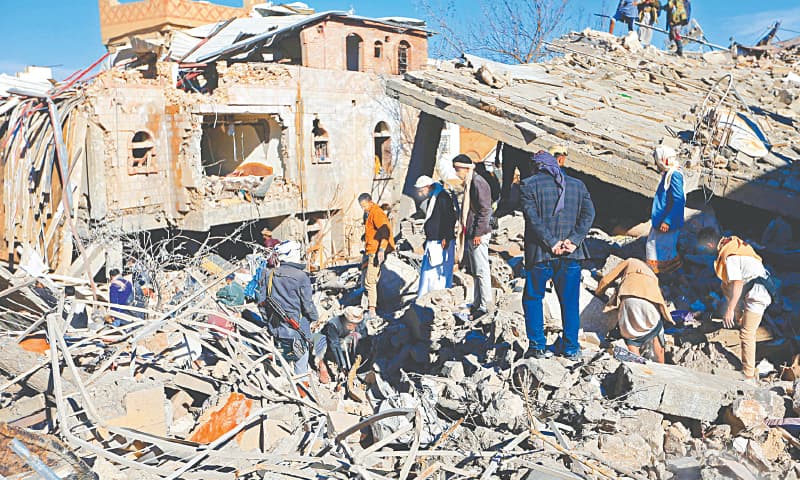
SANAA: Twenty people were killed in air strikes on Yemen’s rebel-held capital, a witness and medical sources said on Tuesday, as the Saudi-led coalition hit back after a deadly attack on Abu Dhabi that sent Gulf tensions soaring.
Residents were combing the rubble for survivors after the strikes levelled two houses in Sanaa, hours after the Houthi fighters claimed a drone and missile attack that killed three people in the Emirati capital.
Akram al-Ahdal, a relative of some of the victims, said 11 people were killed in a single strike on a business district in Sanaa. “The search is still going on for survivors in the rubble,” he said.
The UAE, part of the Saudi-led coalition fighting the Iran-backed Houthis, had vowed a tough response to Monday’s attack, the first deadly assault acknowledged inside its borders and claimed by the Yemeni insurgents.
The coalition launched fresh strikes “targeting Houthi camps and headquarters” in Sanaa on Tuesday, Saudi Arabia’s state-owned Al-Ekhbariya TV tweeted.
Crude prices soared to seven-year highs partly fuelled by the attacks, which exploded fuel tanks near storage facilities of oil giant ADNOC, killing three. The Houthis later warned UAE residents to avoid “vital installations”.
Yemen, whose near seven-year war has killed hundreds of thousands, occupies a strategic position on the Red Sea, a vital conduit for oil from the resource-rich Gulf.
After the attacks, Saudi Arabia’s de facto ruler, Crown Prince Mohammed bin Salman, and Abu Dhabi Crown Prince Mohamed bin Zayed agreed in a phone call to “jointly stand up to these acts of aggression”, UAE state media said.
The rebel attack opened a new front in the Yemen war and further reduced hopes of any resolution to the conflict, which has displaced millions in what was already the Arabian peninsula’s poorest country.
The United States pledged to hold the Houthis accountable, while Britain, France and the European Union also condemned the assault.
“These attacks threaten the security of the United Arab Emirates and regional stability,” French Foreign Minister Jean-Yves Le Drian said.
The targeting of Abu Dhabi follows a surge in fighting in Yemen, including advances by the UAE-trained troops of the Giants Brigade, who drove the rebels out of Shabwa province.
The defeat dealt a blow to the Houthis’ months-long campaign to capture neighbouring Marib, the government’s last stronghold in the north.
Earlier this month, the Houthis hijacked the UAE-flagged Rwabee in the Red Sea, saying it was carrying military equipment — a claim disputed by the coalition and the UAE. The ship’s 11 international crew are being held captive.
Published in Dawn, January 19th, 2022