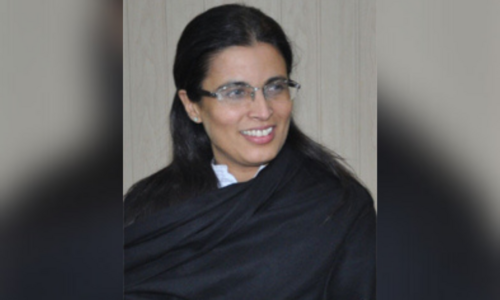
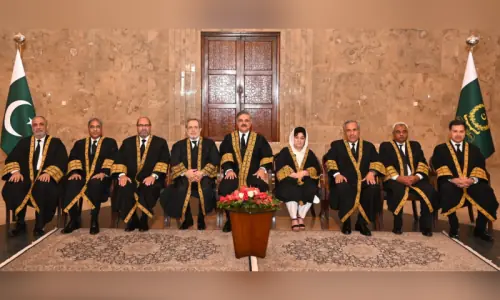
WE have welcome news on the women’s front. A female judge is expected to break fresh ground. Justice Ayesha Malik, a judge of the Lahore High Court, has been nominated by the Judicial Commission of Pakistan for elevation to the Supreme Court. Her appointment will be formally announced following approval by a bipartisan parliamentary committee.
Unsurprisingly, the news is creating quite a stir. This has happened before when the gender barrier has been breached in any walk of public life. Remember the uproar that preceded the debut of Benazir Bhutto on the political scene as prime minister following the elections of 1988.
A question that has been raised in this context in some quarters — certainly not obscurantist ones — gives food for thought. While hailing the move as an honour for women, people have asked if the gender composition of the judiciary really makes any difference to its performance. Whether a woman or a man, a good judge will surely decide a case within the parameters of law and justice.
Justice Nasra Iqbal, a retired judge of the Lahore High Court and an outstanding judge herself, was clear in her opinion. Diversity is enriching and that should be welcome, she stated categorically. For further clarity, it must be said that gender diversity should be encouraged in all professions for the simple reason that men and women have different perspectives on the same issue, however like-minded they may be otherwise. Hence both must be considered.
The female perspective is missing in patriarchal societies.
What is of concern to me is the lack of recognition of the fact that there is a woman’s point of view on every issue relevant to women that cannot and should not be disregarded. It injects a healthy balance into the discourse on all matters. This is basically at the root of the matter that was conceded in the ’60s when there was an influx of women in various professions in Pakistan. The judiciary, which is a very crucial field for women, was slow in transforming itself.
Read: Netizens rejoice as Justice Ayesha Malik gets the nod for Supreme Court elevation
A law may be gender-blind in itself and not discriminate between the sexes. Yet it can be interpreted differently by various judges. In this situation, one’s biases, understanding of various scenarios and personal experiences come into play. That is why verdicts handed down by benches of multiple judges are not always unanimous. Some judges on the bench may dissent and the majority view prevails.
It is the typically female perspective that is missing when there is insufficient female representation. Perhaps Nasra Iqbal had this in mind when she said that a woman understands what is in another woman’s heart.
Men also have their own perspective although those who have been sensitised to the challenges women face are sympathetic towards them. This cannot be assumed for all men in a patriarchal society as ours. Many male judges have biases against women that are often betrayed by their comments during the hearing of a case.
Remember the demeaning treatment meted out by our all-male benches to Mukhtaran Mai who was gang raped on the orders of an all-male village jirga. Retired Justice Nasir Aslam Zahid, who has served as chief justice of Sindh, told me he never realised that women had a different perspective from men until he became chairperson of the National Commission on the Status of Women in 1996-97. The commission had eminent legal female personalities such as Asma Jahangir, Shahla Zia and others as its members. Engaging and deliberating with them was very enlightening for Mr Zahid who learnt how the same law might be seen differently by a woman from how he saw it as a man. He had not been similarly sensitised even when he was federal law secretary and involved in lawmaking.
This holds true for all professions. The more patriarchal a society is, the more the woman’s perspective remains invisible. Small wonder so much is being spent on sensitising the men in a profession where the need is to create awareness of the woman’s point of view. Thus we keep hearing of gender training of lower courts, magistrates, policemen, lawyers and parliamentarians.
That would explain the need to increase the representation of women in every walk of life. Though Nasra Iqbal has suggested five female judges in every court, the number should be more. It is generally believed that in a position of power when women are overwhelmingly outnumbered by men, they cannot be very effective supporters of women. The aim should be to create a critical mass so that the process of change continues without any resistance. This is said to be 40pc — a very high figure that has not been achieved anywhere in the world except in some sectors in the Scandinavian countries which have a strong reputation for gender justice. Justice Malik could set a precedent by taking up the cause of social justice which has a direct bearing on women and children.
Published in Dawn, January 14th, 2022