

'What an amazing milestone': Nasa's James Webb telescope fully deployed in space

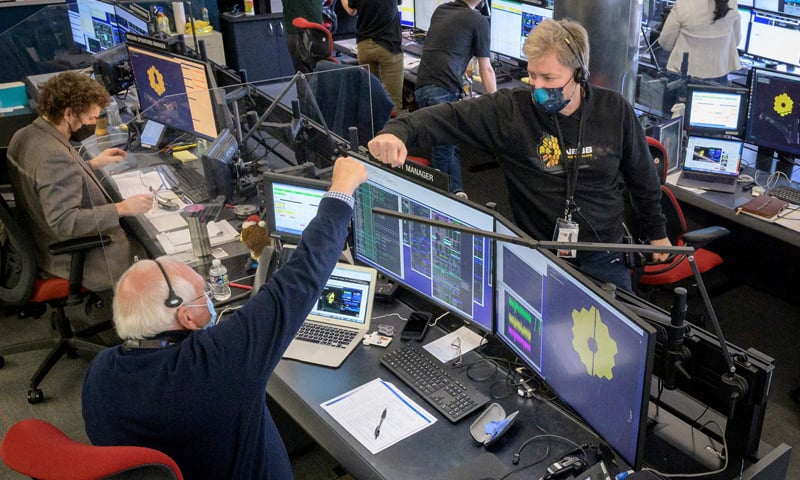

The James Webb Space Telescope completed its two-week-long deployment phase on Saturday, unfolding the final mirror panel as it readies to study every phase of cosmic history.
Engineering teams cheered back at the Space Telescope Science Institute in Baltimore, Maryland as the National Aeronautics and Space Administration (Nasa) announced on Twitter that the final wing was deployed.
“I'm emotional about it — what an amazing milestone,” Thomas Zurbuchen, a senior Nasa engineer, said during the live video feed as stargazers worldwide celebrated.
Because the telescope was too large to fit into a rocket's nose cone in its operational configuration, it was transported folded-up.
Unfurling has been a complex and challenging task — the most daunting such project ever attempted, according to Nasa.
“We've still got work to do,” NASA said as the wing was latched into place. “When the final latch is secure, Nasa Webb will be fully unfolded in space.”
The most powerful space telescope ever built and the successor to Hubble, Webb blasted off in an Ariane 5 rocket from French Guiana on December 25, and is heading to its orbital point, 1.5 million kilometres from Earth.
Though Webb will reach its space destination, known as the second Lagrange point, in a matter of weeks, it still has around another five and a half months of setup to go.
Next steps include aligning the telescope's optics and calibrating its scientific instruments.
Far reaches of the Universe
Its infrared technology will allow it to see the first stars and galaxies that formed 13.5 billion years ago, giving astronomers new insight into the earliest epoch of the Universe.
Earlier this week, the telescope deployed its five-layered sunshield — a 70-foot-long, kite-shaped apparatus that acts like a parasol, ensuring Webb's instruments are kept in the shade so they can detect faint infrared signals from the far reaches of the Universe.
The sunshield will be permanently positioned between the telescope and the Sun, Earth and Moon, with the Sun-facing side built to withstand 230 degrees Fahrenheit (110 degrees Celsius).
Read: Most powerful ever built — exploring Nasa's James Webb Space Telescope
Visible and ultraviolet light emitted by the very first luminous objects has been stretched by the Universe's expansion, and arrives today in the form of infrared, which Webb is equipped to detect with unprecedented clarity.
Its mission also includes the study of distant planets to determine their origin, evolution, and habitability.
The Nasa telescope blog said Saturday's procedure was “the last of the major deployments on the observatory.”
“Its completion will set the stage for the remaining five and a half months of commissioning, which consist of settling into stable operating temperature, aligning the mirrors, and calibrating the science instruments. “






























