Islamabad reports its first confirmed case of Omicron


Islamabad's first case of the Omicron variant of the coronavirus was confirmed on Saturday, a health official said.
Islamabad District Health Officer (DHO) Zaeem Zia told Dawn.com that the case was detected in a 47-year-old male, adding that he was working in Islamabad and had travelled out of city for work-related purposes.
The patient had no history of travelling abroad, he said.
Zia said the variant was confirmed as Omicron following its gene-sequencing, adding that 10 contacts of the patient were traced and subsequently isolated/quarantined.
"Amid the looming threats of Omicron variant, our health teams are prepared to respond as they did in previous waves/variants diligently," he said.
The DHO urged people to follow Covid-19 standard operating procedures, get vaccinated and get booster shots if eligible.
Islamabad Deputy Commissioner Mohammad Hamza Shafqaat also confirmed the development, adding that the patient had a travel history from Karachi.
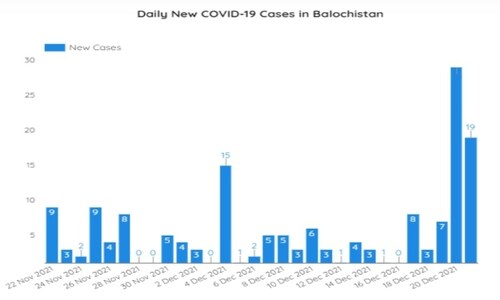
On Tuesday, 12 suspected cases of coronavirus' Omicron variant were reported in Balochistan. Their samples were sent to the National Institute of Health in Islamabad for confirmation of the variant's presence after gene-sequencing.
Pakistan reported its first suspected case of the Omicron variant on December 8. Following its gene-sequencing, Aga Khan University Hospital confirmed it as the new variant on Dec 13.
In a statement, the hospital had said the patient was at home and doing well. So far, no other patients at the hospital had been confirmed to have the Omicron variant, it had added.
On Dec 18, health department sources told Dawn that another case of the variant had emerged in a 35-year-old man in Karachi who had arrived from the United Kingdom on Dec 8.
“His genome sequencing report stating that the infection appeared to be of Omicron has been sent to the National Institute of Health for further confirmation,” an official had said on the condition of anonymity.
'Inevitable' arrival
Last month, Federal Planning Minister Asad Umar and Special Assistant to the Prime Minister on Health Dr Faisal Sultan had sounded the alarm, saying that the arrival of the Omicron variant was inevitable and a matter of time.
"This [strain] has to spread in the whole world as we saw before that when a variant comes, the world is so interconnected that it is impossible to stop it," Umar had said, adding that vaccination was the most logical solution to curb the threat.
Pakistan had placed a complete ban on November 27 on travel from six south African countries — South Africa, Lesotho, Eswatini, Mozambique, Botswana and Namibia — and Hong Kong in the wake of the variant's discovery.
This travel ban was later extended to nine more countries — Croatia, Hungary, Netherlands, Ukraine, Ireland, Slovenia, Vietnam, Poland and Zimbabwe.
Additionally, the National Command and Operating Centre placed 13 countries comprising United States, United Kingdom, Germany, Trinidad and Tobago, Azerbaijan, Mexico, Sri Lanka, Russia, Thailand, France, Austria, Afghanistan and Turkey in category B.
All passengers from these countries need to be fully vaccinated, while everyone above the age of six must possess a negative PCR test report issued not more than 48 hours before boarding.
Omicron has been classified by the World Health Organisation as a "highly transmissible" variant — the same category that includes the predominant Delta variant.