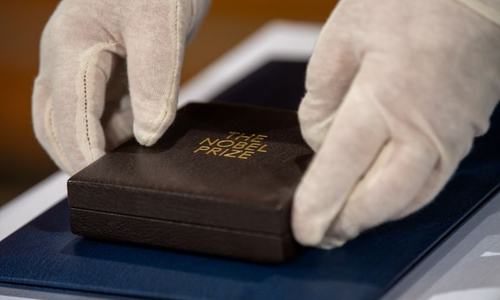
STOCKHOLM: Germany’s Benjamin List and US-based David MacMillan on Wednesday won the Nobel Chemistry Prize for developing a tool to build molecules which has helped make chemistry more environmentally friendly.
Their tool, which they developed independently of each other in 2000, can be used to control and accelerate chemical reactions, exerting a big impact on drugs research.
Prior to their work, scientists believed there were only two types of catalysts — metals and enzymes.
The new technique, which relies on small organic molecules and which is called “asymmetric organocatalysis” is widely used in pharmaceuticals, allowing drug makers to streamline the production of medicines for depression and respiratory infections, among others.
Organocatalysts allow several steps in a production process to be performed in an unbroken sequence, considerably reducing waste in chemical manufacturing, the Nobel committee at the Royal Swedish Academy of Sciences said.
List and MacMillan, both 53, will share the 10-million-kronor ($1.1-million, one-million-euro) prize.
“I thought somebody was making a joke. I was sitting at breakfast with my wife,” List told reporters by telephone during a press conference after the prize was announced.
In past years, he said his wife has joked that he should keep an eye on his phone for a call from Sweden.
“But today we didn’t even make the joke,” List, who is a director at the Max Planck Institute in Germany, said.

“It’s hard to describe what you feel in that moment, but it was a very special moment that I will never forget.”
Asked about what the prize would mean for his future as a researcher, List promised he had “a few more plans.” “I always like to go to the extremes. ‘Can we do things that were just impossible before?’ List told reporters.
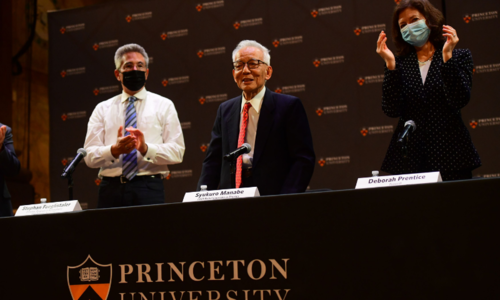
“I hope I live up to this to this recognition and continue discovering amazing things.” MacMillan, born in Scotland but a professor at Princeton University in the US, also thought he was the target of a prank, saying he originally went back to sleep when he started receiving texts from Sweden early on Wednesday.
“I am shocked, and stunned and overjoyed,” MacMillan said in a statement from Princeton University.
“Organocatalysis was a pretty simple idea that really sparked a lot of different research,” the professor added.
Published in Dawn, October 7th, 2021