Palestinian president, Israeli defence minister hold rare talks

Israel's defence minister met Palestinian President Mahmoud Abbas for a rare high-level meeting, but a source close to Prime Minister Naftali Bennett insisted on Monday his government had no plans to reboot peace talks.
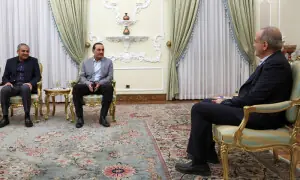
Defence Minister Benny Gantz met Abbas in Ramallah for what were reportedly the first direct talks between an Israeli cabinet member and the 86-year-old Palestinian leader in several years.
The meeting, which Gantz's office said focused on “security policy, civilian and economic issues”, came just hours after Bennett returned from Washington where he met US President Joe Biden.
Biden said he would urge Bennett to find ways “to advance peace and security and prosperity for Israelis and Palestinians”.
According to a defence ministry statement, Gantz told Abbas that Israel “seeks to take measures that will strengthen the PA's (Palestinian Authority) economy”.
“They also discussed shaping the security and economic situations in the West Bank and in Gaza,” and agreed to “continue communicating further,” it added.
A source close to Bennett said that the meeting focused on “issues between the defence establishment and the Palestinian Authority”.
“There is no peace process with the Palestinians nor will there be,” under Bennett's leadership, said the source who requested anonymity.
The Gantz-Abbas meeting included the head of the Israeli military branch responsible for civil affairs in the Palestinian territories, Ghasan Alyan, senior PA official Hussein Al Sheikh and Palestinian intelligence chief Majid Faraj.
Gantz's office said he and Abbas had held “a one-on-one meeting” after the broader talks.
Al Sheikh confirmed the meeting on Twitter but the PA was not immediately available to comment on its substance.
Hamas vs Abbas
Bennett, 49, took office in June as head of an eclectic coalition in which his hawkish party holds only a handful of seats.
He is a long-standing opponent of Palestinian statehood and the former head of a council that lobbies for Jewish settlers in the West Bank, a territory occupied by Israel since 1967.
Jewish settlements in the West Bank are considered illegal under international law.
But despite Bennett's personal views, his government has sought to warm ties with the PA, which had effectively collapsed under former prime minister Benjamin Netanyahu, in power from 2009 until June this year.
Netanyahu, also a pro-settlement right-winger long reviled by Palestinians, further alienated Abbas through his tight embrace of former US president Donald Trump, accused of extreme pro-Israel bias.
Palestinian division
Bennett's government has indicated a desire to boost the PA amid concern over a fresh conflict with Hamas which controls Israeli-blockaded Gaza and is a rival of Abbas's secular Fatah movement.
An 11-day conflict in May between Israel and Palestinians in Gaza marked the worst hostilities in the area since 2014 and unrest has persisted despite an Egypt-brokered ceasefire.
Hamas condemned the Abbas-Gantz meeting, charging that it “deepens Palestinian political division”.
Abbas has tightened his hold over the PA since his election in 2006.
He cancelled elections set for May and July that would have been the first Palestinian polls in 15 years.
The veteran leader cited Israel's refusal to allow voting in annexed east Jerusalem, which Palestinians see as their future capital.
But some Palestinian experts said Abbas baulked when it seemed clear Hamas was poised to rout Fatah at the polls.
Abbas's PA has also come under mounting global criticism over an alleged crackdown on internal opposition following the death in Palestinian custody of a prominent activist.
The United Nations and European Union last week expressed alarm over a spate of arrests targeting leading critics of Abbas and the PA.