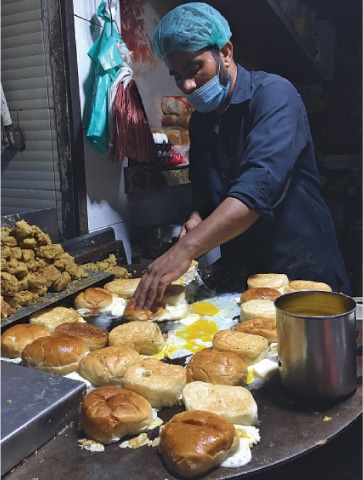
Using his metal spatula, Adnan breaks eggs into cubes of butter melting on a large iron griddle, places buns upside down on the eggs till they’re subtly crispy, presses shami kebab mixture on each bun, sprinkles a little salt and pepper before packing them into burgers. And just like that he churns out at least half a dozen ‘bun plasters’ within a minute.
Adnan appears to have mastered this art of flipping, pressing, siding -- waving his spatula like a magic wand; there’s a rhythm, a pattern to this, and it’s taken him around seven years to reach such dexterity.
This is the dhaba-style Cafe Hameed on Sanda Road, known for the buttery goodness that’s the bun plaster. Since 1955, it’s been ‘the’ hangout spot for students of the MAO College around the corner and ‘hostelites’ of the NCA hostel behind it. If you’re on a budget, there’s nothing like this street delicacy.
What sets this sinful combo of just three items – egg, spicy chicken shami kebab mix and buns, all fried in a whole lot of pure white butter – apart from any other ‘burger’ is the absence of any ketchup, salad or mayonnaise, thus letting one savour the individual tastes of all three components.
Muhammad Omar Hameed and his elder brother took over the affairs of this family business after their father passed away 14 years ago. The ‘cafe’ had been set up by their grandfather, Abdul Rasheed, in 1955 along with their father, Abdul Hameed, and an uncle, who still works here.
What started off as a small roadside hotel adjacent to MAO College is now a dhaba-style cafe just a few metres down the road from the original location. “It used to be a narrow road back then with little traffic. When the government demolished all establishments to widen the road, we moved to this spot around 35 years ago. It used to be open 24 hours, seven days a week till the pandemic broke out,” Omar told Dawn.
This peculiar ‘burger’ with an equally unusual name has cousins, bun kebab and and a shami, and second cousin, vada pav, spread across the subcontinent. “The bun plaster is our specialty that was conceived by my grandfather, father and uncle. Its name is derived from the way it’s prepared: egg and kebab plastered inside a bun and fried in pure white butter. When we started out, burgers or fast food was unheard of here. We created the recipe ourselves and use one small cube of pure white butter, a whole egg, pure chicken shami kebab, black pepper in each bun plaster.”
The cafe has very much become a part of the city’s culture of hanging out at tea stalls and roadside hotels. Their customers span over generations. “This is because the quality of our bun plaster is the same since the beginning. We procure the butter and eggs from the same dairy since day one, the buns are also prepared specially for us by a bakery. Our customers mainly comprise the old students of MAO College who have now become brigadiers, judges, lawyers, bureaucrats, journalists who come over with their families now.”
Omar says this road is known as “student road”, so the cafe used to be a hangout spot when it was operational 24 hours and colleges were open before Covid hit. People would spend entire evenings or even nights here chatting over the bun plasters and cups of tea. What draws new customers is the fact that it’s healthy, he feels, there’s no ketchup, salad or mayonnaise. “Everything we use is pure so it doesn’t feel heavy. People often have at least two bun plasters in a sitting. Earlier, when we didn’t have a lot of resources people would sit on the footpath even across the road, art students would make our portraits. It’s the aroma of the butter that draws everyone to this hotel.”
Apart from the iconic bun plaster, they also offer a slice plaster (bun replaced with bread) and meethay toast with each item priced at Rs70. “Our French toast is different because it’s fluffy and soft, while the homemade ones can get slightly hard.”
Two of Omar’s uncles have also opened up similar bun plaster hotels in the vicinity – one of them right next door, but, he says, their business hasn’t suffered nor have their family ties. The only time they face a slight difficulty is when the road is closed to let Shehbaz Sharif or Hamza Shehbaz pass by on their way to courts, or when large vehicles cross it en route to Bund Road.
His ancestors moved to Lahore from Amritsar and are settled here since then. “We’re so busy with just one hotel that haven’t thought about expanding or felt the need to, but I’m confident that if we ever do it’ll be successful anywhere.”
Published in Dawn, August 15th, 2021