Kashmir remains disputed, UN reminds India

UNITED NATIONS: Two days after India assumed the presidency of the UN Security Council, the spokesperson for the secretary general has clarified that the UN position on the Jammu and Kashmir dispute has not changed.
The clarification followed a statement by India’s UN Ambassador T. S. Tirmurti that the disputed state was now an “integral” part of India.
At a Wednesday afternoon news briefing in New York, UN Secretary General Spokesman Stephane Dujarric was asked what the UN position on this 70-plus years old dispute was. “Our position on Kashmir is well established and has not changed. I will leave it at that,” Mr Dujarric said.
When the journalist asked him to repeat the official UN position on this issue, he said: “You will find it in relevant resolutions. I’m not going to go and repeat it, but ours is unchanged.”
On Monday afternoon, India’s UN Ambassador T. S. Tirumurti addressed a news conference on taking over the UN Security Council’s presidency for the month of August. Asked to explain India’s commitments to UN Security Council resolutions that provide for a plebiscite in the disputed territory, he claimed that Jammu and Kashmir was “an integral part of India.”
Responding to a question about New Delhi’s Aug 5, 2019, action of illegally annexing the Jammu and Kashmir region, he said: “Any change or modification to article 370, like any other provision of the Constitution, is the sole prerogative of the Parliament of the Republic of India.”
In doing so, the Indian envoy glossed over UNSC resolutions that recognise Jammu and Kashmir as a disputed territory and guarantee the right of self-determination to the people of Kashmir.
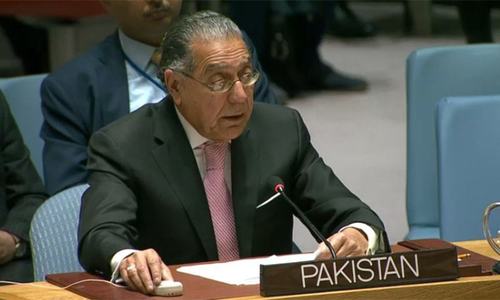
Pakistan’s UN Ambassador Munir Akram, who earlier pledged to “carefully watch” India’s conduct during its UNSC presidency, rejected Mr Tirumurti’s claim as false.
In a rejoinder issued by his office, Ambassador Akram clarified that: a) Jammu and Kashmir is a UN-recognised disputed territory and NOT an “integral part of India.”
b) Security Council resolutions calling for a Plebiscite remain in force and can be abrogated only by the Security Council itself.
c) India’s unilateral and illegal actions of 5th August 2019 violate Security Council resolutions No. 91 and No. 122 and are thus null and void.
d) A dialogue between India and Pakistan will be productive once India: a. Reverses all unilateral and illegal measures imposed on and after August 5, 2019. b. Rescinds the demographic changes initiated in IIOJK, and. Halts its oppression and human rights violations in IIOJK.
The United Nations had also rejected India’s illegal annexation, reminding New Delhi that the UN position on this region was governed by the Charter of the United Nations and applicable Security Council resolutions.
“The Secretary General also recalls the 1972 Agreement on bilateral relations between India and Pakistan, also known as the Simla Agreement, which states that the final status of Jammu and Kashmir is to be settled by peaceful means, in accordance with the Charter of the United Nations,” the United Nations clarified.
“The Secretary General is also concerned over reports of restrictions on the Indian-side of Kashmir, which could exacerbate the human rights situation in the region,” the statement added.
The Secretary General urged “all parties to refrain from taking steps that could affect the status of Jammu and Kashmir.”
Although the Indian ambassador claimed that Jammu and Kashmir was an “integral and inalienable” part of India but said that his government was prepared to discuss with Pakistan any issues and to resolve them bilaterally and peacefully as provided under the 1972 Simla Agreement.
Published in Dawn, August 5th, 2021