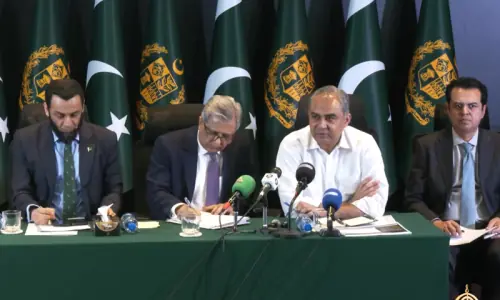
Senate chair’s election not for scrutiny, IHC told

ISLAMABAD: The counsel for Senate Chairman Sadiq Sanjrani on Wednesday informed the Islamabad High Court that since the election to the top slot of the upper house was a part of parliament’s proceedings, it is not subject to judicial scrutiny.
Senator Syed Ali Zafar was arguing before a two-member bench of the IHC, headed by Justice Aamer Farooq, on a petition filed by former prime minister Syed Yousuf Raza Gilani against the rejection of seven votes cast in his favour in the election.
Mr Sanjrani won the election after the presiding officer ruled that the seven votes were not valid since these were not stamped in a proper manner.
According to Barrister Zafar, the presiding officer conducted the proceedings in place of the Senate chairman.
Sanjrani’s counsel argues on Gilani’s petition
He informed the bench that the Constitution had an arrangement to keep parliament and courts off each other’s territories i.e. parliament could neither interfere in sub-judice matters nor question any court proceedings and, similarly, courts could not interfere in any parliamentary proceedings in any manner.
These were “privileges” enjoyed by the Senate, its members, the chairman and any presiding officer (conducting the election of Senate chairman).
Barrister Zafar said the petitioner, Senator Gilani, had himself breached this very privilege by challenging the election of the Senate chairman, which was considered to be internal proceedings of the Senate, in the court that was barred under the Constitution from interfering in the proceedings of parliament.
He further said that if the court decided to serve a notice on the Senate or issue any directive, it would be in violation of the independence of the organs of the state, concept of separation of powers and would amount to contempt.
Barrister Zafar referred to the British law, as well as laws of several other constitutionally-governed states of the world, where there is a concept of parliament, and argued that all these states envisaged, in their constitutions, mechanisms for parliaments to regulate their own procedures and the courts did not have the jurisdiction to interfere in the affairs of any parliament.
He also referred to the famous judges of the English Court who had observed that what is said or done within the walls of parliament cannot be inquired into in a court of law or elsewhere, even if the matter was for the purpose of supporting a cause of action.
Earlier, Farooq H. Naek, the counsel for Mr Gilani, pointed out that the procedure for the election was laid down in Rule 09 of the Rules of Procedure and Conduct of Business of Senate, 2012. There is no methodology on marking at the ballot paper, he argued.
The counsel said that the presiding officer acted in a biased and mala fide manner as he refused to pass a speaking order and failed to take notice of guidelines provided by the Senate Secretariat.
Published in Dawn, July 15th, 2021