8,000MW shortfall shows no signs of abating


LAHORE: With the monsoon getting delayed, the country continues to sizzle under the scorching sun and suffer agonising loadshedding after a hiatus of a few years, as power shortfall stubbornly persists at over 8,000 megawatts — generation of 19,000MW against the peak demand of 27,000MW, claims a Pakistan Electric Power Company (Pepco) official.
According to the power planners, re-gasified liquefied natural gas plants of over 3,600MW were producing less than half of the total generation because of reduced gas supplies, and the hydel contribution fluctuated between (average) 4,600MW and 5,200MW (peak hours when Ghazi Barotha Hydropower Project starts generation) because of water shortage and low dam levels.
Mercifully, atomic energy contribution of around 3,200MW saved the day, which, otherwise, could have been much worse, and thermal generation counted for around 1,500MW. The rest came from independent power producers operating on furnace oil and coal.
“This completed the generation picture on Saturday,” says an official involved in the planning.
“This has been the situation for many days and the important question is how long it will stay this way. It depends on two variables: temperature drop or water supply improvement. However, this scenario has a contradiction: if the temperatures drop, so would the melting of snow and, therefore, water supplies. If they don’t, demand would not come down and keep testing the power generation, transmission and distribution capacity of the country and planners.”
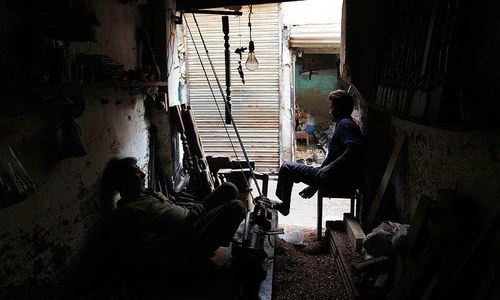
“The country’s urban centres are now suffering up to six-hour load shedding, while no one knows the exact situation in the rural areas,” explains an official of the Lahore Electric Supply Company (Lesco), who says Lahore, the major load centre of the country, was getting just over 70 per cent of its demand of over 5,55MW.
“This naturally translates into eight-hour load shedding if a straightforward calculation is made. However, power outages have many more variables: system constraints, overloading and overheating of the distribution system, revenue-based load shedding and sudden drop in generation for any reason. All these factors add to the power supply problems and making people’s lives miserable,” hesays, adding: “The company is aware of the situation but can hardly do anything about it.”
“This is purely a crisis of leadership and coordination,” points out a former Pepco head.
“After all, dry docking of Floating Storage Re-gasification Unit did not fall from the sky. This is planned months, if not years, ahead and designed for high-water months. Who authorised it in a low-water month instead, and that too without planning an alternative? This needs to be looked into. The revenue-based load shedding does make sense, but only for a limited period. Who has to make those areas payment-compliant?
The power planners are now doing such load shedding for more than four years. For how long can it be justified without making efforts to correct the situation? If six plants with reciprocating engines (Nishat Power, Nishat Chunian, Attock Power, Atlas Power, Liberty Power and Hubco Narowal) can arrange furnace oil for themselves and do it on time, why can the government not? Someone needs to answer these questions before trying to technically explain and justify load shedding,” the former official concludes.
Published in Dawn, July 4th, 2021