Bangladesh tightens restrictions

SREENAGAR: Tens of thousands of migrant workers fled Bangladesh’s capital on Sunday on the eve of a tightened lockdown that will curtail most economic activity and confine people to their homes as coronavirus infections soar.
Restrictions on activities and movement have been in place since mid-April as cases and deaths jumped.
Infections declined in May but started to rise again this month, with over 5,000 new cases and a pandemic-high of 119 deaths on Sunday, according to the health ministry.
The resurgence has prompted the government to toughen restrictions in stages from Monday, with economic activity — including shops, markets, transportation and offices — to shut down by Thursday.
People will be ordered to stay at homes while only emergency services and export-oriented factories continue operations. The coming closure has sparked an exodus from Dhaka, the capital.
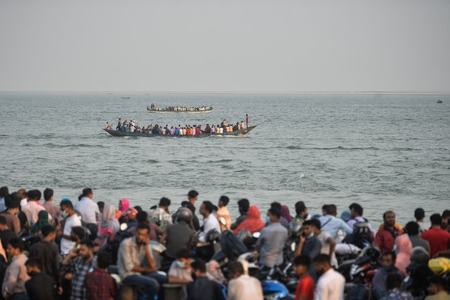
With public inter-city transportation already suspended since June 22, people have squeezed into rickshaws, hopped onto motorbikes and even hired ambulances to make their way to their villages.
Ferries have been operating on overdrive, with some running services 24 hours a day and cramming more than 1,000 passengers onto each trip.
“We don’t want them to overcrowd the ferry. But they don’t listen,” said police sub-inspector Mohammad Reza. “There is a mad rush of people.” A senior official at the state-run Bangladesh Inland Water Transport Corporation said that at least 50,000 people had crossed the river by ferries on Sunday alone.
At a river station in the rural town of Sreenagar about 70 kilometres south of Dhaka, thousands queued from early on Sunday to cross the Padma, a tributary of the Himalayan river the Ganges.
“We did not have any choice but to leave the city,” Fatema Begum, 60, said while waiting for a ferry.
“During lockdown, there is no work. And if we don’t work, how do we pay rent? So we packed up everything and are going back to our village.” Mohammad Masum, 30, a street vendor in Dhaka, said it was better to return home and “spend the time with family” than be confined in the capital.
Bangladesh has reported more than 880,000 infections and just over 14,000 virus deaths, but experts say the actual toll could be much higher due to possible underreporting.
Published in Dawn, June 28th, 2021