0
0

PESHAWAR: Thirteen irrigation channels being built in the northern parts of Khyber Pakhtunkhwa will help reduce the intensity and destruction caused by the glacial lake outburst (Glof) phenomenon.
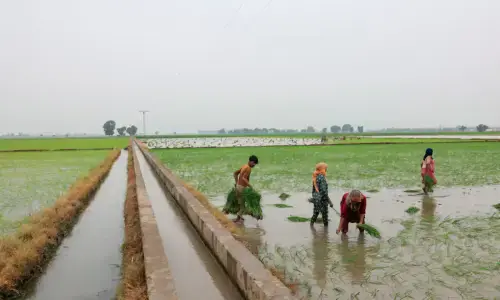
These channels, which near completion, will also help control soil erosion, water losses and will improve the livelihood of farming community in the Glof-prone areas, according to officials.
“By the end of the current year, dozens more irrigation channels will be constructed in the disaster-prone areas,” deputy director planning on-farm water management Mohammad Asif told Dawn.
On-farm water management is a wing of the provincial agriculture department.
The construction of irrigation channels is financially supported by Glof-II project in eight valleys located in Upper and Lower Chitral, Upper Dir and Swat.
The project is funded by Green Climate Fund and implemented by the federal ministry of climate change in collaboration with the United Nations Development Programme and the KP government.
Glof-II project coordinator for KP, Fahad Bashir Bangash said it envisaged building the institutional capacity of the various provincial government departments to plan for any climate change-induced disaster, and strengthening the capacity of communities on early-warning system and building their resilience.
Out of the 13 under-construction irrigation channels, he said, five were in Swat, four in Lower Chitral and two each in Upper Chitral and Upper Dir.
Each irrigation channel has been constructed on glacial-fed tributaries which will provide water to the local community for drinking and irrigation purposes and will also reduce the intensity of floods caused by Glof.
Mr Bangash said recently different UNDP teams visited Chitral, Upper Dir and Swat to examine the under-construction infrastructure.
The teams also held meetings with the local communities, who expressed satisfaction over the construction of irrigation channels, he added.
A budding concern for the mountain communities is the rapid melting of glaciers in the region.
Onset of summer brings with it more chances of floods caused by Glof from the numerous glacial lakes formed naturally, posing great threat to the locals living in close proximity as well as downstream.
Under the Glof-II project, interventions are being undertaken for enhanced protection of the people against the rising risks of climate change-induced disasters, he said.
Published in Dawn, May 23rd, 2021