4
4

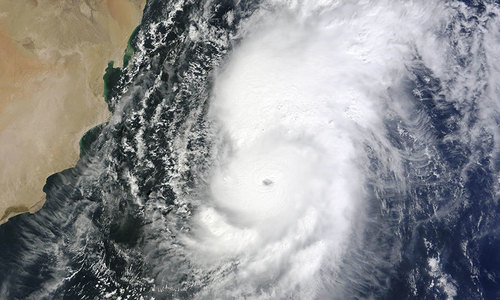
KARACHI: The cyclonic storm “Tauktae” is likely to further intensify into a ‘very severe cyclonic storm’ during the next 18 to 24 hours and move further in the northwest direction, reaching the Indian city of Gujarat by May 18 afternoon or evening, the Meteorological department said in an advisory on Saturday.
However, the department said, the storm didn’t pose a serious threat to Pakistan’s coastal areas.
However, it has forecast dust/thunderstorm-rain with few moderate to heavy falls and gusty winds of 60-80km per hour in Thatta, Sujawal, Badin, Tharparkar, Mirpurkhas, Umerkot and Sanghar districts during May 17- 20.
“The cyclonic storm in southeast Arabian Sea intensified into a severe cyclonic storm that tracked northwestward at a speed of 18km and lay centered at a distance of about 1,310km south-southeast of Karachi. The maximum sustained winds around the system centre are 100-120 km/h gusting to 140Km/h,” it said.
Dust/thunderstorm-rains with isolated moderate/heavy falls and gusty winds of 40-60km/h are also likely in Karachi, Hyderabad, Jamshoro and Shaheed Benazirabad during May 18-20.
“It’s changing its position and does not pose the same threat as it looked like on Saturday morning. It seems that we will likely experience its minimal peripheral effects including thunderstorm-rains and gusty winds,” said Sardar Sarfaraz of the Met department, adding that it was the first cyclonic storm of this year.
About Karachi, he said the city influenced by the system was expected to see very hot weather conditions. “It shouldn’t be called a heat wave. The rise in temperature ranging between 41 and 43 degrees Celsius is likely to occur when the sea breeze will be blocked by the system in the next two days.”
There was no cyclonic storm last year while there were at least seven in 2019, he added.
Recalling the history of cyclones in Arabian Sea, the Met officials said it was last in 2010 when the coastal belt of Balochistan was badly hit by heavy rains caused by the cyclonic storm named Phet.
“Initially the coastal cities skipped any major impact of Phet in 2010,” said Mr Sarfaraz. “It was because the cyclone moved and landed on the Oman coast. However, the reoccurrence of the cyclonic impact led to heavy rains in Balochistan coastal cities and more than 400 millimetres downpour was recorded within less than 24 hours.”
The most destructive cyclone in recent years to hit Pakistan was Cyclone 2A, which slammed into Sindh cities Thatta and Badin in May 1999 as a strong Category 3 equivalent storm, he said.
“It caused massive destruction and loss of lives. After that no cyclonic storm in Arabian Sea has hit any of our coast directly,” said Mr Sarfaraz.
In 2007, he said, the coastal cities of Gwadar, Pasni and Ormara were partially hit after Cyclone Yemyin made its landfall along the Balochistan coast.
Published in Dawn, May 16th, 2021