WHO approves China’s Sinopharm vaccine



GENEVA: The World Health Organisation approved a Covid-19 vaccine from China’s state-owned drugmaker Sinopharm for emergency use on Friday, a boost to Beijing’s push for a big role in inoculating the world.
The vaccine, one of two main Chinese coronavirus vaccines that collectively have already been given to hundreds of millions of people in China and elsewhere, is the first developed by a non-Western country to win WHO backing. It is also the first time the WHO has given emergency use approval to a Chinese vaccine for any infectious disease.
A WHO emergency listing is a signal to national regulators that a product is safe and effective. It also allows it to be included in COVAX, a global programme to provide vaccines mainly for poor countries, which has hit supply problems.
“This expands the list of Covid -19 vaccines that COVAX can buy, and gives countries confidence to expedite their own regulatory approval, and to import and administer a vaccine,” WHO Director-General Tedros Adhanom Ghebreyesus told a briefing.
The WHO had already given emergency approval to Covid -19 vaccines developed by Pfizer-BioNTech, AstraZeneca, Johnson & Johnson and, last week, Moderna.
The decision to approve Sinopharm’s vaccine was taken by WHO’s technical advisory group, which began meeting on April 26 to review the latest clinical data as well as Sinopharm’s manufacturing practices.
A separate group of WHO experts, the Strategic Advisory Group of Experts (SAGE), voiced concern this week over data provided by Sinopharm on the risk of serious side-effects in some patients, but was confident in the vaccine’s ability to prevent disease, according to a document reviewed by Reuters.
Tedros said that, following the approval, SAGE had recommended that adults over 18 receive two doses of the Sinopharm vaccine.
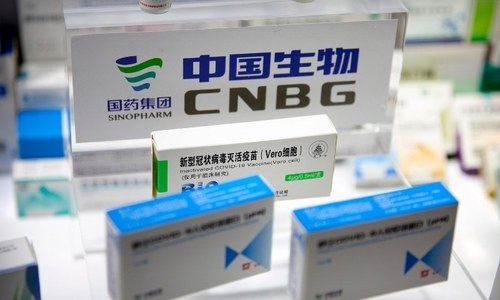
SAGE found an efficacy of 78.1 per cent after two doses in multi-country Phase III clinical trials, according to the document. The vaccine’s developer, Beijing Biological Products Institute, a unit of Sinopharm subsidiary China National Biotec Group, had announced an efficacy of 79.34pc.
The WHO has said it could reach a decision on China’s other main Covid-19 vaccine, made by Sinovac Biotech, as soon as next week. The technical experts reviewed it on Wednesday.
China has deployed around 65 million doses of the Sinopharm vaccine and more than 200 million doses of the Sinovac shot. Both have been exported to many countries, particularly in Latin America, Asia and Africa, many of which have had difficulty securing supplies of vaccines developed in the West.
Published in Dawn, May 8th, 2021