Top court orders Indian government to present oxygen plan
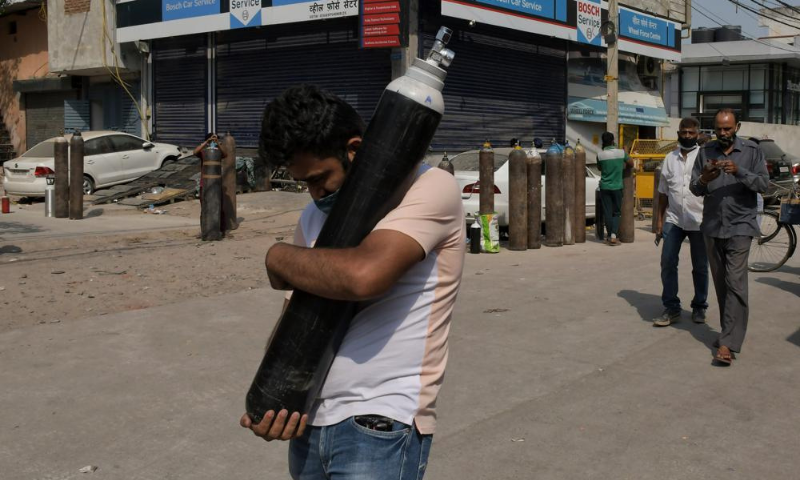

India’s government, facing calls for a strict coronavirus lockdown to slow the devastating surge in infections, was ordered by the top court on Wednesday to submit a plan on meeting New Delhi hospitals’ oxygen requirements within a day.
The Supreme Court decided against immediately punishing officials for failing to end a two-week-old erratic supply of oxygen to overstretched hospitals.
“Ultimately putting officers in jail or hauling officers for contempt will not bring oxygen. Please tell us steps to solve this,” Justice Chandrachud said during the hearing.
It stayed the contempt notice issued to the government by a lower New Delhi High Court for defying its order on supplying adequate oxygen to more than 40 New Delhi hospitals. The government officials found guilty could have faced six months in prison or a fine.
With 382,315 new confirmed cases, India’s tally has risen to more than 20.6 million since the pandemic began. The Health Ministry on Wednesday also reported 3,780 deaths in the last 24 hours, bringing the total to 226,188. Experts believe both figures are an undercount.
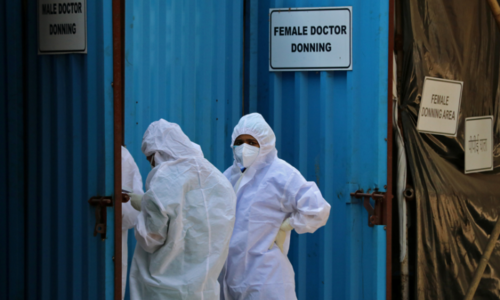
On Tuesday, the New Delhi High Court court, which had summoned two Home Ministry officials for a hearing on Wednesday, said that the grim reality is that hospitals are reducing the number of beds and asking patients to move elsewhere. The court is hearing petitions filed by several hospitals and nursing homes struggling with irregular oxygen supplies.
“You can put your head in the sand like an ostrich, we will not. We are not going to take no for an answer,” Justices Vipin Sanghi and Rekha Palli said.
Raghav Chaddha, a spokesman for the Aam Aadmi Party governing New Delhi, said hospitals were getting only 40 per cent of their 700 metric tonnes requirements through the federal government, and the local government was arranging additional supplies to meet the shortfall and setting up new oxygen plants.
The latest wave of infections since April has pushed India’s health care to the brink with people begging for oxygen cylinders and hospital beds on social media and news channels.
In pictures: India’s virus catastrophe worsens, with ‘horrible’ weeks ahead
Bodies have been piling up at cremation grounds and in graveyards with relatives waiting for hours for the last rites.
Dileep Kumar, a student, said he was asked by hospital authorities to shift his father to another hospital in Ghaziabad, a town on the outskirts of New Delhi, after it ran out of oxygen on Tuesday.
Authorities are scrambling to add more beds, sending oxygen from one corner of the country to another, and scaling up manufacturing of the few drugs effective against Covid-19.
Rahul Gandhi, a leader of the opposition Congress party, said this week “a lockdown is now the only option because of a complete lack of strategy by the Indian government.”
Modi’s government is reluctant to impose a national lockdown for fear of the economic fallout. Modi said last month that it should be the last resort.
But nearly a dozen states have imposed curbs on their own.
The most populous state of Uttar Pradesh, with 200m people, implemented a five-day lockdown this week. The country’s second and third most populated states of Maharashtra and Bihar are also under lockdown with varying curbs.
Efforts to scale up the vaccination drive are hampered by the shortage of doses. India, a country of 1.4 billion, has so far administered 160m doses.
The global community is extending a helping hand. The United States, Britain, Germany and several other nations are rushing therapeutics, rapid virus tests and oxygen to India, along with some materials needed for India to boost its domestic production of Covid-19 vaccines.