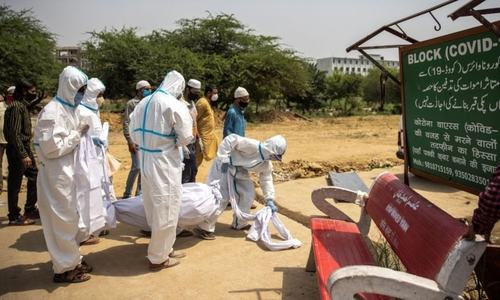
Mumbai gravedigger works 24-hour shifts as India's Covid-19 death toll soars

Two or three months into the Covid-19 crisis, Mumbai gravedigger Sayyed Munir Kamruddin stopped wearing personal protective equipment and gloves.
"I'm not scared of Covid, I've worked with courage. It's all about courage, not about fear," said the 52-year-old, who has been digging graves in the city for 25 years.
India is in the midst of a second wave of coronavirus infections that has seen at least 300,000 people test positive each day for the past week, and its Covid-19 infections rise past 18 million.
Health systems and crematoriums have been overwhelmed. In Delhi, ambulances have been taking the bodies of Covid-19 victims to makeshift crematoriums in parks and parking lots, where bodies are burned on rows and rows of funeral pyres.
Kamruddin says he and his colleagues are working around the clock to bury Covid-19 victims.
"This is our only job. Getting the body, removing it from the ambulance, and then burying it," he said, adding that he hasn't had a holiday in a year.
Though it is the middle of the Muslim fasting month of Ramazan, Kamruddin told Reuters his trying job and the hot weather has kept him from fasting.
"My work is really hard," he said. "I feel thirsty for water. I need to dig graves, cover them with mud, need to carry dead bodies. With all this work, how can I fast?"
Yet Kamruddin's faith keeps him going, and he doesn't expect aid from the government anytime soon.
"Our trust in our mosque is very strong," he said. "The government is not going to give us anything. We don't even want anything from the government."