Pakistan's focus shifting from geopolitics to geo-economics, Qureshi informs Hungary Dialogue
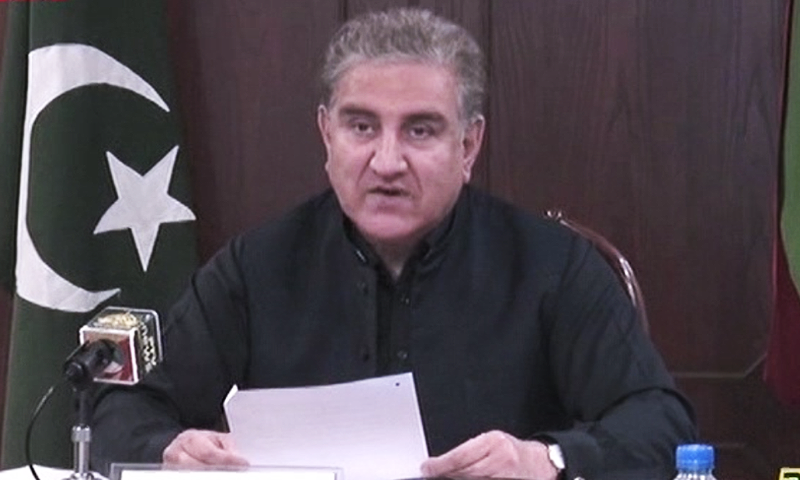


Foreign Minister Shah Mahmood Qureshi said on Thursday that Pakistan, under the leadership of Prime Minister Imran Khan, had undergone a transformation and shifted its priorities from geopolitics to geo-economics.
The foreign minister was addressing the Pakistan-Hungary Dialogue in Islamabad where he explained the shift and said it would be based on a new "economic security paradigm".
"My government, under the leadership of Prime Minister Imran Khan, attaches great importance to enhancing Pakistan's trade and economic relations with our partners. The transformed Pakistan's focus is shifting from geopolitics to geo-economics.
"Our new economic security paradigm has three essential pillars: peace, development partnerships and connectivity."
Qureshi said that the structural and policy reforms undertaken by the government had led to an improved investment ecosystem, further citing Pakistan's improvement by 28 ranks on the World Bank's ease of doing business index and by 58 positions in the starting a business indicator.
"Our investment policy offers equal treatment for local and foreign investors. All economic sectors are now open to foreign direct investment."
The foreign minister urged Hungarian companies and businesses to come and invest in Pakistan and pursue joint venture opportunities with Pakistani businesses. He said Pakistan had introduced new incentives, backed by regulatory ease, in key sectors such as renewable energy, electric vehicles, construction, IT and tourism.
Qureshi also pointed out that Pakistan's policy on alternative energy had been "found attractive by influential international players" and this was one avenue which Hungarian investors could look into.
"Hungarian investors are also encouraged to invest in special economic zones. Sixteen special economic zones are being established [...] with liberal incentives, infrastructure, investor facilitation services and reduced cost of doing business."
The foreign minister stated that Hungary wielded expertise in the fields of agriculture, food industry, environment industry, water resource management, engineering technology, vocational training and urban planning.
Pakistan, meanwhile, was known for its textiles, leather, surgical goods, pharmaceuticals and food items such as mangoes and rice where it has a comparative advantage, said Qureshi. Both countries could stand to benefit from collaboration in these fields and make use of the other's experience.
"The government of Pakistan has eased visa requirements for businessmen from 95 countries including Hungary. The business community can avail visa on arrival facility," he said, adding that similar facilitations were also available for tourists such as online visas and fast visa processing.
The foreign minister noted that the improved security situation in the country, along with government reforms, had led to many European countries revising their travel advisories for Pakistan and international airlines resuming their flights to Pakistan.
"Increasing air linkages will ease travel of Hungarian businessmen and tourists to Pakistan.
"We hope that Hungary will revise its travel advisory for Pakistan which would enable the two countries to further enhance our linkages."
Qureshi said the relations between the two countries were "rooted in history" and expressed his appreciation for Hungary's support in the extension of the Generalised System of Preferences-Plus (GSP-Plus) status for Pakistan.
He said the scheme had paid off greatly with the "volume of trade between Pakistan and the European Union having doubled" and the EU becoming the largest trading partner of Pakistan.
"I hope that dividends would now translate into increase in Pakistan-Hungary trade as well as the current volume of $44.3 million is definitely much lower than the potential."
He also thanked the Hungarian government for providing scholarships to Pakistani students who "would forge strong people-to-people links" between the countries.
"There is a need for exchanging high level visits between our two countries as well as at the private sector level to consolidate the existing level of cooperation.
"When the pandemic situation improves, we must focus on exchanging business delegations and promoting bilateral trade and investment opportunities," said Qureshi, adding that Pakistan looked forward to hosting the second session of the Pakistan-Hungary Joint Commission on Economic Cooperation in Islamabad this year.