ISLAMABAD: The Executive Committee of the National Economic Council (Ecnec) on Thursday approved Rs322.44 billion worth of 13 major development projects to be executed over the next few years.
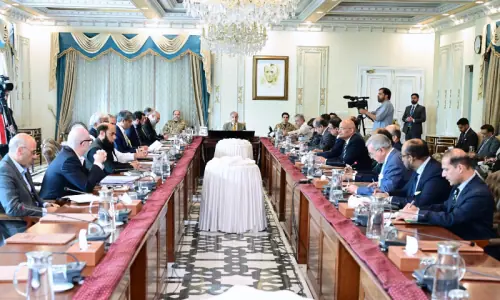
A meeting of Ecnec, presided over by Finance Minister Dr Abdul Hafeez Shaikh, approved Rs13.260bn worth of World Bank-funded human capital investment projects (health sector) in Khyber Pakhtunkhwa to improve availability, utilisation and quality of primary healthcare facilities in four districts of the province.
The projects would cover a local population of about 8.4 million, besides 500,000 refugees.
Ecnec also approved acquisition of 10,000 kanal of land for Swat Motorway Phase-II to be sponsored by the Khyber Pakhtunkhwa government and executed by Pakhtunkhwa Highway Authority (PKHA) through Federal Public Sector Development Programme (PSDP) funding of Rs20bn. It involves construction of about 80km of four-lane motorway from Chakdara to Fatehpur.
The committee approved the project and recommended completion of such projects on a public-private partnership basis.
Karachi’s water project K-IV among 13 projects to be completed in next few years
Ecnec also approved construction of additional two-lane and widening/rehabilitation of existing two-lane carriageway of Shikarpur-Rajanpur section of the Indus Highway (N-55) to be executed by the National Highway Authority (NHA) at an estimated cost of Rs44.704bn, including Rs40.234bn funding from the Asian Development Bank and Rs4.47bn from the federal government.
The Rs25.552bn Greater Karachi Water Supply Scheme (K-IV) 260 MGD (Phase-I) was also approved by Ecnec for additional water supply to Karachi.
The Karachi Water and Sewerage Board and Wapda will be the executing agencies for the project. It is funded on a 50:50 basis by the federal and provincial governments.
The committee also approved Rs24.494bn worth of Sindh Resilience Project (Irrigation Component) for construction of small dams to address the drought-prone areas of Sindh, including system for improving resilience phase-II in Malir (Karachi), Jamshoro, Thatta, Shaheed Benazirabad, Sukkur, Khairpur, Qambar-Shahdad Kot and Tharparkar districts.
The project will be sponsored and executed by the Irrigation Department of Sindh. The provincial government has funding share equal to $11.50 million (7.5pc) and $141.5m loan from the World Bank (92.5pc share).
Another component of the Sindh Resilience Project was approved at a total revised cost of Rs15.31bn. The Provincial Disaster Management Authority, Sindh, will be the executing agency for the project.
The project will contribute to overall needs for enhancing resilience to natural disasters, including public health emergencies, in 29 districts of Sindh.
The meeting also approved Rs46.98bn worth of Nai Gaj Dam Project for Dadu district, to be executive by Wapda and the Irrigation Department of Sindh. The project targets conservation of the available flood flows up to a gross storage capacity of 300,000 acre feet and power generation of 4.2MW and help irrigate about 56,739 acres of land and help control soil erosion.
The meeting also approved construction of 69-km-long (four-lane) Sambrial-Kharian Motorway — another project of the NHA — at an estimated cost of Rs43.383bn. It will be a high-speed toll road facility which will start from Sambrial city and end at Lahore-Sialkot Motorway. It will be constructed with the involvement of the private sector on a build-operate-transfer basis.
The meeting also approved about Rs14.75bn worth of Balochistan Integrated Water Resources Management and Development Project, to be sponsored and executed by the Irrigation Department of Balochistan.
The project is designed to increase agricultural production, generate employment opportunities and develop agro-based industry across 11 districts in Balochistan.
Published in Dawn, March 12th, 2021