Focusing on the manufacturing sector


Despite some increase in the country’s commodity production, the fragile external demand and high domestic costs, driven by a surge in domestic and global inflation, continue to pose serious risks to investment potential and export-oriented sustainable growth.
However, Pakistan got a bit of relief as most local petroleum products posted increased output during the 8MFY26: petrol production rose by 13.51pc, high-speed diesel by 19.72pc, LPG by 12.96pc, and kerosene by 10.39pc. Only furnace oil output dropped 2.08pc.
On April 21, the power division spokesman said electricity generation from hydel sources has surged to 5,000 megawatts during peak night hours since April 17. As a result, no load management was carried out during peak night hours in the central region on April 17, 18 and 19, supported by the availability of an additional 400MW from the southern region.
Prime Minister Shahbaz Sharif has also stepped in to restore coal supplies to Sahiwal Power Plant 1, a 1,320-megawatt base-load facility, where coal stocks had fallen to levels sufficient for only a few days of operation, while the Railway authority and plant management remained engaged in prolonged legal and procedural disruptions. The Pakistan Railway freight transport team has been reshuffled following disruptions in coal movement for base-load power stations in Punjab.
Pakistan cannot grow if it continues to treat its own savings as suspicious, wrote Nadeem Ul Haque and Shahid Kardar in their article titled ‘Rethinking black money’ published in this newspaper on April 22. Growth will come from using these savings productively. Instead of seeing domestic wealth as a problem, the article said, “the country needs to treat it as a valuable resource.”
The government is taking various measures to boost production in various sectors, though bottlenecks remain
Mr Haque, who is a deputy chair of the Planning Commission and Mr Kardar, former State Bank of Pakistan (SBP) governor, argue that the money that is neither criminal nor deliberately hidden “simply exists outside the formal system because that system is complicated, unreliable or unfair. Many people earn in cash informally, or hold assets in someone else’s name, because dealing with official systems is difficult or risky.” They point out that ‘Pakistan struggles to grow and depends heavily on foreign aid’.
Worth noting here is that Pakistan’s freelancers’ earnings grew by 50 per cent to $856 million year-on-year in the third quarter of the current fiscal year, according to SBP, despite multiple challenges and issues of internet disruption and electricity loadshedding.
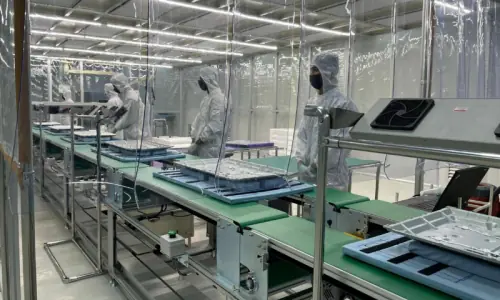
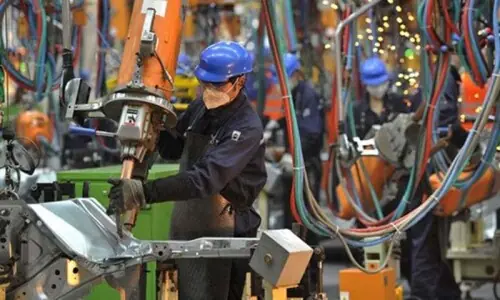
Pakistan’s large-scale manufacturing (LSM) sector recorded a year-on-year growth of 5.89pc in July-February 2025-26. Industrial output rebounded over the past five months. The food group grew by 5.26pc for 8MFY26. Wheat and rice milling rose by 2.32pc, owing primarily to improved crop harvests.
But Pakistan’s import bill surged 15.22pc to $7.09 billion in 9MFY26 from $6.15bn in the same period of last year. Simultaneously, export of raw food items recorded a steep fall to $3.80bn from $5.75bn, a drop of 33.90pc, according to official data. The overall textile sector grew by a paltry 1.61pc in 8MFY26.
The government says the country’s economic growth will remain under pressure during the current and next fiscal years as Rs173bn was taken from federal development allocation to finance fuel subsidies owing to the lagged inflationary impact of supply disruptions following the US-Israel war on Iran. This will result in an economic slowdown and affect our growth target of 4.2pc, Planning and Development Minister Ahsan Iqbal said at a news conference on April 20.
To foster industrial growth and boost investors’ confidence, Maritime Affairs Minister Muhammad Junaid Anwar Chaudhry announced the same day the creation of a state-of-the-art 400-acre small industrial estate at Port Qasim. This project will first deliver fully developed infrastructure, including main boulevards, landscaping and essential utilities, ensuring a business-ready environment prior to allotment.
Land misuse and speculative trading will be strictly curbed. Investors will be required to submit feasibility plans, establish industrial units and ensure operationalisation before any transfer of land ownership is permitted. The minister says it is strictly tied to genuine industrial activity.
Despite the vast contributions of small and medium enterprises (SME), Chief Operating Officer of JS Bank Ltd, Atif Malik, says Pakistan’s financial landscape is restrained by structural barriers, inadequate institutional backing, and a persistent underestimation of entrepreneurial capacity. At the heart of the challenge lies a banking framework historically anchored in collateral-backed lending.
In Pakistan, SMEs receive, says the banker, less than 8pc of total private-sector credit. By contrast, he notes Bangladesh allocates more than a fifth of its lending portfolio to small businesses.
On April 16, the National Assembly Standing Committee on Finance approved a bill to give state land on lease free of cost to private developers for the development of special economic zones (SEZs) and barred courts from taking cognisance of commercial legal disputes related to these zones. The government will give 6,000 acres of land in Karachi to developers without charging any money, said Qaiser Sheikh, the Federal Minister for Investment.
Though the terms of the lease have yet to be finalised, any developer can obtain 1,000 or 500 acres of land on lease where the zone is at least 1,000 acres.
Published in Dawn, The Business and Finance Weekly, April 27th, 2026