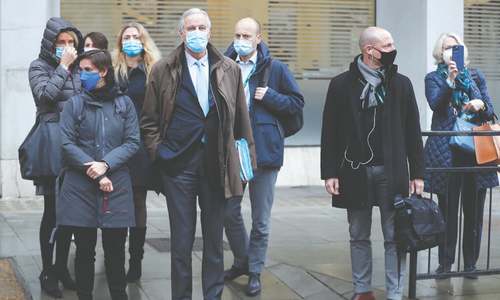
Last-ditch efforts to clinch post-Brexit trade deal begin


BRUSSELS: British and EU negotiators embarked on probably their final two-day scramble to secure a post-Brexit trade deal on Sunday, after failing for eight months to reach an agreement.
David Frost and Michel Barnier took up from where they left off in EU headquarters in Brussels, ending a two-day pause after a fruitless week of late-night wrangling in London.
“We’re working very hard to try to get a deal. We’ll see what happens in the negotiations today,” Frost told reporters as he arrived at the city’s Gare de Midi train station.
Talks were expected to continue late into Sunday night and Monday, as a small team of the most senior negotiators haggled over the last remaining, but most contentious issues.
The EU and UK still differ over fishing rights and fair trade rules
Meanwhile, UK Prime Minister Boris Johnson will reportedly lobby European leaders, after a call with EU chief Ursula von der Leyen on Saturday ended with the sides still wide apart.
The pair’s next call will be on Monday evening and then the 27 EU leaders will gather in Brussels on Thursday for a two-day summit planned to tackle their own budget dispute, but which will now once again be clouded by Brexit worries.
Johnson and von der Leyen issued a downbeat joint statement after their call, with divisions still wide over fishing rights, fair trade rules and an enforcement mechanism to govern any deal.
“Whilst recognising the seriousness of these differences, we agreed that a further effort should be undertaken ... to assess whether they can be resolved,” they said.
Ireland would be the EU member worst hit by a failure to strike a deal and Foreign Minister Simon Coveney insisted agreement was crucial to avoid more damage to an economy already reeling from the Covid-19 pandemic.
Failure “doesn’t make any political sense and it certainly doesn’t make any economic or social sense either”, he told RTE news.
“And for all those reasons, I think that the negotiating teams and senior politicians will find a way of getting a deal here, but at the moment we’re in a difficult place as we try to close it out,” he said.
Britain formally left the EU in January, nearly four years after a referendum on membership that split the nation down the middle and two months after Johnson won an election touting what he claimed was an “oven ready” Brexit deal.
The UK is bound to the EU’s tariff-free single market until a post-Brexit transition period expires at the end of the year — an immovable deadline by which time the two sides must try to agree on new terms for their future relationship.
Published in Dawn, December 7th, 2020