13th International Urdu Conference concludes



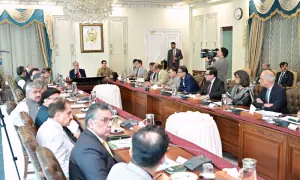
KARACHI: The four-day 13th International Urdu Conference organised by the Arts Council of Pakistan Karachi ended here on Sunday by unanimously adopting a resolution that called for, among other things, effective arrangements to tackle second wave of Covid-19 especially for the underprivileged segments of society, to raise voice for the rights of Kashmiris and their right for self-determination, and setting up of translation centres at national and provincial levels so that books on art, philosophy, literature and economics can be translated into Urdu.
The resolution was read out by the council’s president Ahmed Shah. After that, writer Anwar Maqsood addressed the audience using his trademark witty narration. He linked the pandemic (waba) with works of Urdu literature. He then turned the attention of his satire to women poets. Talking about one poet he said she didn’t know what the opening two lines of a ghazal is called, to which he replied “for men poets matla and for her matli.”
The concluding session was preceded by two sets of conversations: one with actors Suhail Ahmed and Humayun Saeed. Director Nadeem Baig had chitchat with Saeed. The actor was of the opinion that 80 to 90 per cent of those who write TV plays lack depth in their writing. He lauded senior playwrights such as Haseena Moin and Noorul Huda Shah for the way the create characters and give depth to them. He iterated that we [showbiz fraternity] need to engage the senior writers for creative ventures. On the current situation arising out of Covid-19 he said digital medium will have both good and bad effects on show business. Once the coronavirus vaccine is available in the country cinemas will reopen and things will look up again, he added.
Baig said that the cinema industry was in need of government intervention.
Actor Yasir Hussein interviewed Suhail Ahmed. On how he became an actor, Ahmed said his grandfather (nana) used to do a literary show on the radio [who inspired him with his scholarliness]. He remarked that for an artist, if his passion becomes his profession, he should count that as his blessing. He profusely praised his colleagues such as Umar Sharif and the late Moin Akhtar and Amanullah. Lamenting the government’s lack of focus on culture, he commented that the nations that don’t care about their culture face the danger of a changed geography.
Earlier, the day began with an insightful session moderated by Rizwan Zaidi on the 100 years of criticism in Urdu literature presided over by renowned Indian scholar Shafey Kidwai [via video link]. He said if we try to analyse the 100 years of criticism in Urdu we will notice that it has a link to the Aligarh Movement. Mohammad Husain Azad, who penned Aab-i-Hayat, Maulana Altaf Hussain Hali and Shibli laid the foundation for criticism. Referring to an earlier speaker’s statement he argued that whatever is being produced locally will have a global dimension. In that context he gave the example of Rajinder Bedi’s story Ek Chador Maeli Si.
Before him Dr Hameeda Shaheen [from Lahore] talked about the effects of cultural invasion on Urdu criticism. She related it to western civilisation and pointed out that both rejection and acceptance of its impact need to be examined.
Dr Qazi Abid said our critics of fiction have tried to attach more importance to the voice of the author in reference to his life or psychological context of story and less to the content (matn). But content has the ability to have its own voice heard, which is why today we find new opinions about stories written by the likes of Premchand.
Published in Dawn, December 7th, 2020