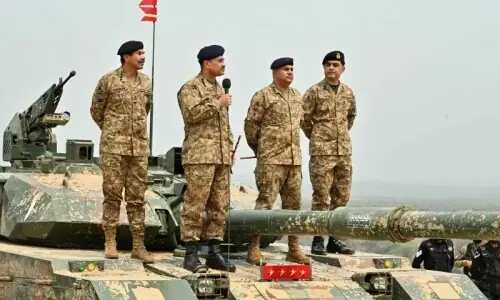
Inter-Services Public Relations (ISPR) Director General Lt Gen Ahmed Sharif Chaudhry said on Thursday that Pakistan was “prepared” as he highlighted the armed forces’ indigenous military capabilities.
He made the remarks while addressing a press conference in Islamabad as the nation commemorated the one-year anniversary of Marka-i-Haq. The deputy chief of naval staff (operations), Rear Admiral Shifaat Ali, and the deputy chief of air staff (projects), Air Vice Marshal Tariq Ghazi, were also present alongside him.
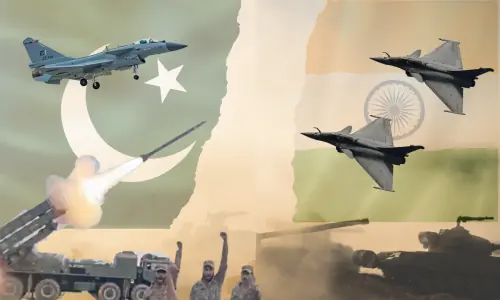
Last year’s military conflict with India, starting from the April 22 Pahalgam attack to the end of Pakistan’s Operation Bunyanum Marsoos, with a ceasefire ending a military escalation between the two countries on May 10, has been called “Marka-i-Haq” (Battle of Truth) by the state.
“We welcome you to ISPR on this happy day,” he said at the outset of his presser, congratulating the nation on the one-year anniversary of Marka-i-Haq.
He said that the country’s armed forces had risen to the nation’s expectations and defeated a much larger enemy with multi-domain operations.
“Today, we are not going to dwell a lot on what happened … We are going to spend more time from May 2025 to May 2026,” he said, adding that they would expand on the “strategic consequences” of the conflict.
Strategic consequences of Marka-i-Haq
He said that there were 10 strategic consequences of Marka-i-Haq, the first of which was that the Indian narrative of painting Pakistan as a source of terrorism stood buried.
He said that an attempt had been made to portray, without evidence, that Pakistan had perpetrated terrorism in India. He said that it had been one year since the Pahalgam incident, yet the questions that Pakistan had asked remain unanswered.
“Where is the evidence?” he asked. “Nobody buys this … you are the biggest terrorist. Nobody listens to them, nobody believes them,” he said.
He said that the second consequence was the consolidation of Pakistan as the net security stabiliser in the region. He said that Marka-i-Haq showed who was controlling and dominating the escalation, adding that India escalated the conflict based on a lie.
The DG ISPR said the “biggest ambassador of security in the region” was Pakistan and its leadership.
Coming to the third strategic consequence of Marka-i-Haq, he said it was related to “our eastern neighbour, unfortunately”, saying it was the “politicisation of Indian military leadership and militarisation of Indian political leadership.”
“This is what’s happening over there”, he said, adding that India’s military, which used to be professional, had “unfortunately been politicised”.
“You will come across several examples of this,” he added. “You heard their air chief marshal a few months after Marka-i-Haq … [saying] ‘I got to know today that even we downed some planes’ … That is politicisation of the military leadership … Why are you trying to make jokers out of your admirals, and generals and marshal? Don’t do that.”
On the other hand, the DG ISPR continued, “We have placed the facts as they are.”
Moreover, he said, Indian politicians appeared more like “warmongers”, going by their statements. The DG ISPR asserted that the politicisation of the military and militarisation of politics was “dangerous”.
Moving on to the fourth strategic consequence, he said it was the global acknowledgement of India’s efforts to externalise its internal problems and internalise its external problems while using terrorism as a state tool.
He said India’s problems included the repression of minorities and Kashmiris. This, he said, “comes from a false sense of entitlement and this hubristic attitude”.
The DG ISPR said India did not want to solve its internal issues, and hence, was externalising them by levelling allegations that Pakistan was behind terrorism in the neighbouring country. He said these issues needed to be addressed “politically and internally”.
“Kashmir is an internationally recognised dispute,” he said. “It’s not your internal problem for you to make demographic changes there … you cannot do that.”
He reiterated the allegations India was backing terrorism in Pakistan, further stating that “they were even behind terrorism in their own country and would then accuse others”.
But, he added, what changed after Marka-i-Haq was that the world recognised how they operated.
He said the fifth consequence was the “exposure of the true face of the Indian media and its discredited information operations”. The DG ISPR also noted that Indian authorities had started “shutting down Pakistani media” during Marka-i-Haq and this practice was still ongoing.
But that did not solve the problem, he said, adding that his advice to India was to speak the truth.
“That’s what Pakistan did … The only thing that can survive in today’s information domain is the truth. Tell people the truth. But somehow the Indians think they can work their [way] around lies. It doesn’t work anymore.”
He said the sixth consequence was the “transformed character of warfare”. Elaborating on this, he said this covered multi-domain operations, non-contact warfare, synergy, proxies and information.
The DG ISPR explained that warfare was not limited to borders anymore. “It’s [fought] on land, in the sea, in the air, in cyberspace … and in the minds. It’s cognitive as well.”
He said Pakistan’s armed forces were prepared to fight against India during Marka-i-Haq in all those domains. “We were prepared back then, and we are prepared today as well.”
The seventh consequence, he said, was Pakistan’s proven potential and the resilience to combat multifaceted challenges. The eighth was the loud and clear establishment of deterrence, he said.
“Anyone who thinks there is space for war between two nuclear neighbours is crazy. That is madness. Only a madman can think about. You want to do it, then there should be no doubt about our resolve,” he said.
He said that the ninth consequence was that Pakistan was recognised as a geopolitically significant and responsible middle power. He said that the last, but most important consequence, was the unshakeable synergy between the people, the government and the armed forces, “which we call the Bunyanum Marsoos effect”.
Surge in terrorism post-Marka-i-Haq
During the press conference, he also presented figures on counterterrorist efforts post-Marka-i-Haq. He said that India was given a “lesson of their life” and they fell back on their default option, which was terrorist proxies.
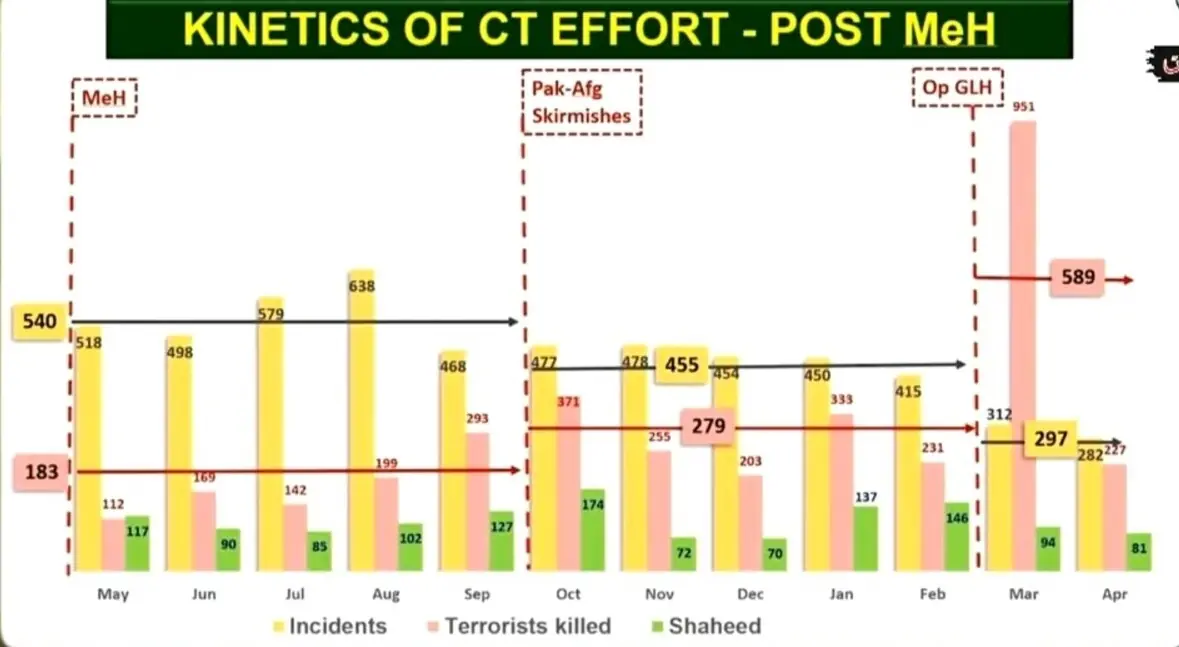
“We saw a surge in terrorist incidents post-Marka-i-Haq,” he said, showing the figures on the screen. He said that in October, Pakistan struck terrorist support infrastructures in neighbouring Afghanistan. He said that the number of incidents subsequently went down.
He reiterated that terrorism in Pakistan was being carried out by India and Afghanistan was being used as a base of operations.
“You saw who India called after they were taught a lesson in Marka-i-Haq. The Afghan Taliban regime’s so-called foreign minister,” he said.
During his press conference, the DG ISPR also played clips of Indian media, saying, “The field marshal and Pakistan; I think they feature in their dreams day and night. They need to grow up.”
‘Homegrown’ military capabilities
After multiple videos were played, the DG ISPR said they had presented an overview of “what our dear neighbour has been doing” over the past year. He added that he would also go on to detail what Pakistan had been doing during this period.
He recalled that during a press conference on May 11, 2025, he had stated that Pakistan’s military capability seen during Marka-i-Haq was just 10 per cent of the armed forces’ power potential.
“We are prepared; if anyone wishes to test us, they are more than welcome,” he said after a video showing the armed forces’ prowess played on the screen.
He added that the clips displayed Pakistan’s indigenous military capabilities. “This is homegrown.”
These included surface-to-air missiles; cruise missiles; the establishment of Army Rocket Force Command; main battle tanks; long-range artillery; ship-launched anti-ship missiles; UAVs, quadcopters and drones; short, medium and long-range anti-drone systems; loitering munitions; electro-optical satellites; and an integrated artillery fire control system.
The military spokesperson highlighted the significance of security in the world today, adding that “when we say that the armed forces, with the support of the people of Pakistan, will defend Pakistan’s territorial integrity and sovereignty at all costs, we mean it. And we will do it, come what may.”
However, he added, this operational preparedness, military capability and technical prowess would not be meaningful if it was not backed by the resolve and the strategic clarity of the leadership.
After several videos had played, he highlighted Pakistan’s emergence as a regional player and net security provider.
“We are not seeking conflict, we are not seeking war. But we know how to defend ourselves with honour and dignity,” he said. At the conclusion of the presentation, the national anthem played.
‘Historic and memorable conflict’
Rear Admiral Ali then addressed the press conference, saying that Marka-i-Haq was a “historic and memorable” conflict. He said that prior to the conflict, the “enemy prided itself on its naval capability”.
“Their navy used to consume a big share of their defence budget, there were claims of ‘Made in India’; they were self-proclaimed net security providers and there was the status of blue water navy,” he said.
He said, however, that the question remained as to why their naval force was unable to “muster the courage against Pakistan”.
He added that the Indian navy tried to deploy its vessels in the northern Arabian Sea during Marka-i-Haq.
“And the only purpose behind this move was to target our naval assets and inflict economic harm on us by disrupting our naval trade and waterways.
“But due to the effective strategy of the Pakistan Navy, [traffic] in all our waterways remained uninterrupted, our instalments remained protected and ports remained operational,” he added.
Rear Admiral Ali said the Pakistan Navy continued to surveil the enemy’s activity through its modern system during Marka-i-Haq.
“The Pakistan Navy and Pakistan Air Force (PAF) were prepared to destroy Indian aircraft carrier Vikrant,” he recalled, adding that, however, the Indian navy did not move beyond its sanctuaries.
“We want peace, but that is not our weakness. We are not negligent towards our preparation … for any eventuality that may befall us,” he said.
‘Tally is at 8-0’
Air Vice Marshal Ghazi also addressed the presser. He said the national leadership decided on a direction, and subsequently, the tri-service plans were coordinated under the guidance of the field marshal.
He said that the PAF had to do two things immediately: a strong defensive air posture and implement the highest alert level. He said that PAF integrated its multi-domain assets in preparation and added that the Indian Air Force initially carried out aggressive deployments and tried to conceal critical systems.
He said that the enemy, however, was forced to recompose its force composition, revealing “what we had been looking for”.
Talking about the armed forces’ preparation, he said, “The enemy remained oblivious of our preparations”.
He said that the PAF’s defensive posture meant that “our aerial sovereignty was impregnable”.
Air Vice Marshal Ghazi also said that after India attacked, PAF’s defensive posture transformed into an offensive posture.
“The killers embedded into PAF’s packages started targeting their topline fighters,” he said, adding that “we are now at eight-zero”.
The air force official elaborated that during the air battle, Pakistan fought “aggressively, but responsibly”.
“In that intense BVR vs BVR (beyond visual range) fight, with multi-domain interplay, we were able to curtail the enemy and its capability to apply itself as a network and integrated force package,” he explained.
AVM Ghazi said the “confirmed kills” included four Rafales, one Su-30, one MiG-29, one Mirage 2000 and an “expensive multi-role unmanned aerial system”.
The senior PAF official noted that a number of aircraft were also damaged and some of them remained unrecoverable.
Ghazi said from the PAF’s integrated command centre, Air Chief Marshal Sidhu let this operation “flawlessly”.
“The way it was choreographed — it was an exceptionally synchronised operation. The enemy’s massive offensive was converted into a crippling, I should say, ambush for their high-tech fighters.”
“So this spectacular performance shocked the enemy, and the outcome was unprecedented and also inconceivable for the IAF,” he added.
He said, “The IAF was not to be seen in the air for the rest of the conflict.”
AVM Ghazi said the PAF also curtailed India’s pre-emption on May 10, while the digital space was also being disrupted.
“Our killer drones, stand-off long-range and hypersonic vectors struck 16 air bases, key operational infrastructure of strong military relevance, BrahMos sites, critical command and control centres, including the one at Barnala and two of their most prized S-400 batteries.”
The airstrike on Indian S-400 batteries was carried out by indigenously manufactured JF-17 Block III aircraft.
Shedding further light on the PAF’s dominance during the conflict, the AVM said the air force had “dominance” and the PAF was “targeting them all across and at will”.
“PAF’s response was overwhelming and shocking for the adversary.”
“Marka-i-Haq has established one thing that is very close to our hearts — the prowess of PAF’s homegrown kill chain, which had integrated all operational elements into a single formidable force.”
Further elaborating on PAF’s operations during Marka-i-Haq, he said it was the first time in the history of warfare that full-spectrum, multi-spectrum operations were demonstrated.
“Marka-i-Haq provides a classical case study for air warfare experts.”
He added that with India’s power and transport infrastructure disrupted, critical installations crippled, modern Rafales shot down, S-400 batteries neutralised, and IAF grounded, “the enemy was, in effect, out of options” during Marka-i-Haq.
“We recognise that this won’t be our last war, and our next war won’t be along similar lines. That’s why, with passion and focus, the chief of air staff has been building the PAF of the future, with leadership already at the drawing board, defining the parameters of the next war.”
“PAF is aggressively pursuing capability enhancement to retain its qualitative edge the next time it is put to the test,” said the senior PAF official.
He elaborated that there are “160 projects under development” and a number of them are near completion. He did not specify what projects are being work upon.
“They will very soon be contributing to the capabilities of the PAF in particular and Pakistan in general… PAF capabilities have been substantially enhanced over the past year. They reflect accelerated institutional modernisation that has gone on since May 2025,” said AVM Ghazi.
“We would share more, but I thought we should leave some things out so we can surprise you next time.“
When asked about the induction of the Chinese fifth-generation J-35A stealth fighter, Ghazi said the Pakistan Air Force had established an “initial collaborative mechanism” on the aircraft and that the option would be available before the requirement emerged.
New Delhi’s ‘hubristic mindset’
During the question-and-answer session that followed the briefing, the military spokesperson was asked how Pakistan had defeated India despite the latter’s numerical, technological and strategic edge. DG ISPR emphasised that, if there was one factor behind Pakistan’s victory, it was the “hubristic mindset” of New Delhi’s political and military leadership.
“Their assessment of Pakistan is absolutely wrong. Where did they get the idea of Akhand Bharat? Where did they get the idea that they will define the destiny of the people of this region? This is the problem, this sense of self-entitlement, I think that is the problem where they have miscalculated, and they are miscalculating hugely,” he stressed.
The military spokesperson noted that India misconceived that it would defeat Pakistan by spending 10 times more on defence and that there was a rift between the armed forces and the public.
“There is nobody who has the power to come between the people and the armed forces. We are together; that’s the destiny of the people of Pakistan and … the armed forces,” he emphasised.
“It’s not an army for the elites, it’s an army for the poor. They (India) had the wrong idea, this is the strategic miscalculation that they made.”
Echoing Air Vice Marshal Ghazi, DG ISPR said that Pakistan is “preparing for the future war”.
He further said Pakistan did not underestimate India and “placed them where they are, but we also know who we are”.
“If you want to add one difference, that is belief within every child in Pakistan; that martyrdom is a reward and not to be afraid of,” DG ISPR stressed. “Our pilots, when they went up, had no fear.”
DG ISPR said there are multiple “tangible and intangible” factors behind Pakistan’s victory.
“Lastly, and this is the most important: this country is a gift from Allah. It’s not an ordinary country in the world; it’s a country of consequences. Our ancestors put their identity aside … and said that this country was made by Allah,” he added.
“We have this great belief in our destiny of Pakistan. When you add all these things together, no power on earth [can defeat us], so then how can India intimidate us?”
Moving on to the Indus water issue, he stated that the military is the “final instrument of violence in the hands of the state … and the people of Pakistan”.
“Water is an inalienable right; nobody can be allowed to play with the destiny of 250 million people, because without water there is no life,” he added.
“How and when this instrument of violence is used is in the hands of the Pakistani people and government.”
‘Any threat to Saudi Arabia is a threat to us’
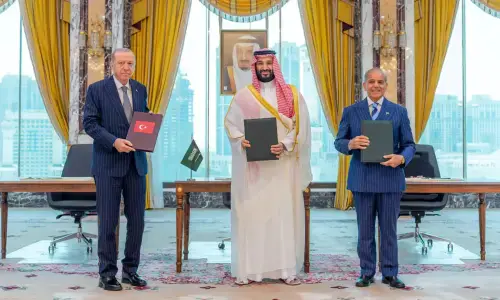
In reply to another question, DG ISPR said that the mutual defence pact between Pakistan and Saudi Arabia was of great importance, as Pakistan had been “chosen” to guard the two holiest sites in Islam.
“We were chosen to protect Harmain Shareefain (Masjid al-Haram in Makkah and Masjid-i-Nabawi in Madinah), and protecting Harmain Shareefain is intrinsically linked to Saudi Arabia’s national security,” he explained.
“Any threat to Saudi Arabia is a threat to us, and Saudi Arabia values Pakistan’s security. It’s mutual,” Lt Gen Chaudhry said, adding that the pact was a “manifestation” of decades-old Pakistan-Saudi ties across multiple domains.
“We will fulfil our duty and follow what we promised.”
Asked about “political-military diplomacy” in the region after the end of the Middle East war, DG ISPR highlighted that the military is a “component” and that “it is for the political leadership to decide”, referring the question to the Foreign Office.
Afghanistan not a rational player
DG ISPR, in response to a question about the status of Operation Ghazab lil-Haq in Afghanistan, stated that the operation is still ongoing.
“The Ministry of Information and Broadcasting’s press release talked about a time-specific temporary pause,” he said.
“Ghazab lil-Haq’s linkage is with the actions of the Afghan Taliban regime. We have got nothing against Afghanistan and especially the people of Afghanistan.”
Noting that Pakistan has been “the best of brothers” and hosts to Afghans, the military spokesperson said there was no better example of brotherhood and hospitality.
“Pakistan’s Ghazab lil-Haq is one part of the national response against terrorism,” he added.
“One part of the 14-point National Action Plan is kinetics, and Ghazab lil-Haq is a sub-part of that. It’s absolutely ongoing.”
Highlighting that the number of terrorist incidents has declined and the number of terrorists killed has increased since the start of the operation, Lt Gen Chaudhry said, “At the same time, in the context of negotiations, Pakistan has one logical, just requirement: do not allow your soil to be used to launch terrorist attacks in Pakistan.”
“Yet they let kharji Noor Wali and these people stay there. The United Nations says two dozen terrorist organisations are based in Afghanistan.”
Noting Pakistan’s role in mediating the US-Iran talks to end the Middle East War as a “rational state”, DG ISPR said Afghanistan is not a rational player, nor does it behave like a state.
“Is there any rational player who makes terrorism the country’s main source of income? Does any rational player deprive its communities of the right to equal development and expression?” he asked.
“Do not compare us to them.”
DG ISPR emphasised that terrorism “at the behest of these Indians cannot be accepted”.
Responding to a follow-up question on internal politics, the military spokesperson said that dialogue is the privilege of political parties, but they have to speak to each other.
He stated clearly that the military is “not a stakeholder in the politics of Pakistan”, nor does it represent a specific creed, sect, language or political ideology.
“We come from the people of Pakistan and the people of Pakistan come from us,” Lt Gen Chaudhry said.
“We say ‘resolve your issues through dialogue.’ Who stops them? It’s none of our business.”
DG ISPR, fielding another question on the closure of the US consulate in Peshawar, said, “The security of all consulates and its members is always the responsibility of the host state, and therefore all actions for this are always in place.”
He referred the question to the Foreign Office, but noted that different diplomatic missions perform their own independent safety assessments, and that foreign diplomats are of “high value” to Pakistan.
‘Pakistan’s jugular vein’
Asked about whether Pakistan’s increased diplomatic standing can lead to a resolution of the Kashmir issue, the military spokesperson reiterated Pakistan’s constant stance on Kashmir.
“You have heard it from the field marshal [Asim Munir]: Kashmir is and always will be Pakistan’s jugular vein, and that the people of Kashmir have to decide their future, as per the UN Security Council resolution and as per the right of self [determination] granted to them, they have to decide on their future,” Lt Gen Chaudhry said.
“We believe that whenever the people of Kashmir make a choice, they will be absolutely clear, and that is Pakistan,” he added.
“The hearts of Kashmiris and Pakistanis beat as one.”
He noted that the world is recognising what is happening in India-occupied Kashmir, and that the salience of the Kashmir question rises as Pakistan’s stature increases.
“The fates of Pakistan and Kashmir are intertwined. Our intentions and thoughts on Kashmir will never change, nor will the Kashmiris’ intentions and thoughts about us. This is a journey which we need to complete; we have the same destination, which we will achieve through self-determination and values,” DG ISPR added.
He said Pakistan’s military and political leadership is working on the issue “day and night” to grant Kashmiris their rights through “diplomatic, political and legal means”.
“Pakistan doesn’t believe in what Indians are doing: repression, aggression and all sorts of nonsense which they have spread both inside and outside the region,” Lt Gen Chaudhry replied.
Towards the conclusion of the presser, DG ISPR reiterated that Pakistan, as a “net regional stabiliser”, had dominated and controlled escalation during the conflict with India.
“On the other hand, there is a player with a hubristic mindset whose political rhetoric and vested interests initiated this, generating politicisation, Hindutva-isation and media frenzy,” he said, noting that the armed forces were “part of a larger choreography being carried out at the state level”.
“Terrorism is India’s default setting. When they are beaten on the battlefield, they will return to terrorism. It’s in their nature,” he added.
Lt Gen Chaudhry said that, in the event of another Indian military operation, Pakistan could “show them the reality in a matter of minutes”.
“Nothing gives us more pleasure than putting their minds to rest,” he said in response to a question.
“[Operation] Sindoor 2, 3, 4, 5 or 6 — do what you want. You’re most welcome. I don’t have a problem, nor do my brothers in the navy and air force, nor does any child of Pakistan.”