Modi to lay foundation of Ayodhya temple on Aug 5

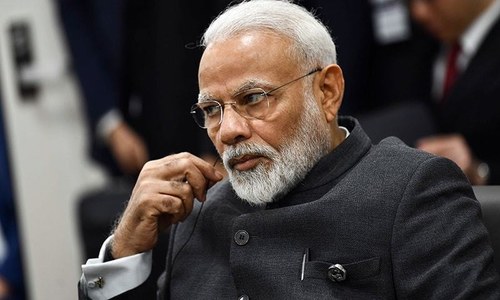
NEW DELHI: Indian Prime Minister Narendra Modi will attend a groundbreaking ceremony next month for a Hindu temple on a disputed site in northern India where a 16th century mosque was torn down by Hindu hard-liners in 1992, according to the trust overseeing the temple construction.
The ceremony is set for Aug 5, a date organisers said was astrologically auspicious for Hindus but that also marks a year since the Indian Parliament revoked the semi-autonomous status of Muslim-majority state, occupied Jammu and Kashmir.
The symbolism was impossible to miss for both supporters and opponents of Modi's Hindu nationalist Bharatiya Janata Party, or BJP, whose manifesto had for decades included pledges to strip restive Kashmir's autonomy and to build a temple to the Hindu deity Ram where the Mughal-era mosque once stood, a site in the city of Ayodhya in Uttar Pradesh state.
Because the coronavirus is still rampaging across India, which has reported the world’s third-highest caseload, the ceremony will be broadcast live on state television and the number of participants and spectators will be limited, according to Vishwa Hindu Parishad, or the World Hindu Organisation, a Hindu nationalist group allied with the BJP.
The temple will serve as an enduring and immortal beaming center of social harmony, national unity and integration and awakening of the feeling of Hindutva, or Hindu way of life, the organisation’s spokesperson Vinod Bansal said in a news release on Saturday.
A century-long dispute over the site was resolved last year following the BJP’s landslide election victory.
In November, the Supreme Court ruled in favour of the temple trust, saying that Muslim petitions would be given five acres at an alternative site.
Hindus hard-liners have long contended that Mughal Muslim invaders built a mosque on top of a preexisting temple in the ancient city of Ayodya.
A December 1992 riot following the destruction of the mosque sparked communal violence in which about 2,000 people were killed, mostly Muslims.
Meanwhile, the trial in the demolition court case continues to be heard in a special court.
An architect from Ahmedabad, Gujarat, Modi’s home state, has proposed a towering sandstone structure 161 feet (49 metres) high with five domes.
Yogi Adityanath, Uttar Pradesh’s chief minister and a Hindu monk, requested that Ayodhya hold a special cleaning and purification ceremony and for all of the city’s temples to light oil lamps ahead of Modi’s visit, the Press Trust of India news agency reported.
Adityanath said the occasion marked the end of a 500-year struggle, PTI reported.
Published in Dawn, July 27th, 2020