Over 1 million: India joins US, Brazil in grim coronavirus club


India on Friday became the third country in the world to record more than one million cases of the new coronavirus, behind only the United States and Brazil, as infections spread further into the countryside and smaller towns.
Given India's population of around 1.3 billion, experts say, one million is relatively low — but the number will rise significantly in the coming months as testing increases, further straining a healthcare system already pushed to the brink.
The pandemic has surged in the country in recent weeks as it spread beyond the biggest cities, pushing India past Russia as the third most infected country last week.
Explainer: Why India cases are rising to multiple peaks
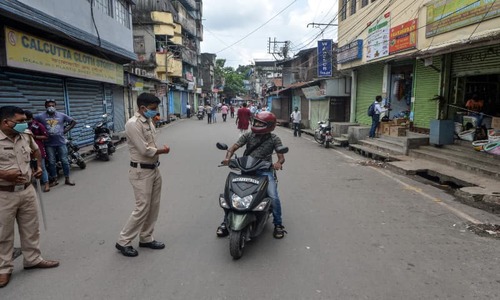
Authorities imposed fresh lockdowns and designated new containment zones in several states this week, including the largely rural Bihar state in the east and the southern tech hub Bengaluru, where cases have spiked.
But officials have struggled to enforce the lockdowns and keep people indoors.
India recorded 34,956 new infections on Friday, taking the total to 1,003,832, with 25,602 deaths from Covid-19, federal health ministry data showed. That compares to 3.6 million cases in the United States and two million in Brazil — countries with less than a third of India's population.
Epidemiologists say India is still likely months from hitting its peak.
“In the coming months, we are bound to see more and more cases, and that is the natural progression of any pandemic,” said Giridhar Babu, epidemiologist at the non-profit Public Health Foundation of India.
“As we move forward, the goal has to be lower mortality,” he said. “A critical challenge states will face is how to rationally allocate hospital beds.”
The last four months of the pandemic sweeping India have exposed severe gaps in the country's healthcare system, which is one of the most poorly funded and has for years lacked enough doctors or hospital beds.
The Indian government has defended a strict lockdown it imposed in March to contain the virus spread, saying it helped keep death rates low and allowed time to beef up the healthcare infrastructure. But public health experts say shortages remain and could hit hard in the coming months.
“As a public health measure, I don't think the lockdown had much impact. It just delayed the virus spread,” said Dr Kapil Yadav, assistant professor of community medicine at New Delhi's premier All India Institute of Medical Sciences.
"The million cases so far recorded likely left out many asymptomatic ones," he said. “It's a gross underestimate.”
Rahul Gandhi, leader of the opposition Congress party, urged Prime Minister Narendra Modi to take concrete steps to contain the pandemic, tweeting that the number of infections will double to two million by August 10 at this pace.
Millions of migrant workers, left stranded in the cities by the lockdown in March, took long journeys home on foot, some dying on the way while others left without work or wages.
Several states including Bihar, to which many of the migrants returned, have witnessed a surge in cases in recent weeks as the lockdown has been eased to salvage a sagging economy.
Babu predicts India will not see a sharp peak and decline.
“The surges are shifting from one place to another, so we cannot say there will be one peak for the whole country. In India, its going to be a sustained plateau for some time and then it will go down.”