Kurram residents suffer as drinking water goes scarce


 0
0
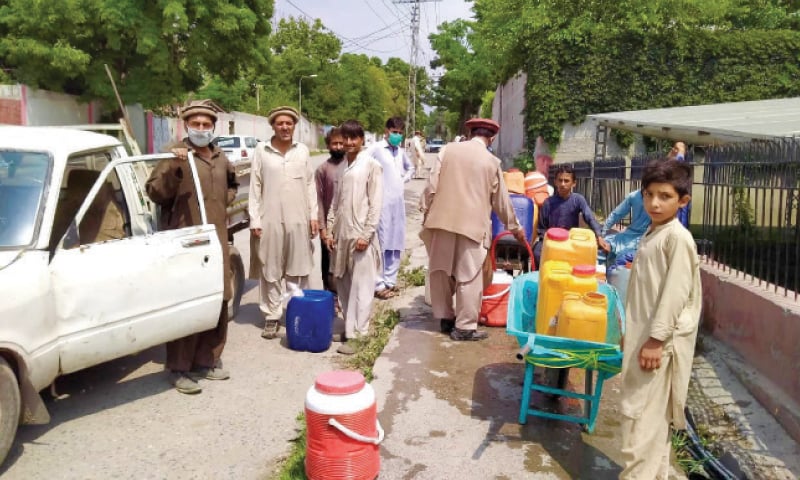

KURRAM: Taj Nargis, a resident of Parachinar in Kurram tribal district, has gotten into the habit of rationing water for the last four years or so.
Whether it is cooking or washing, Nargis, a housewife, has to watch every litre to make last for a week her scarce stock delivered through a water tanker.
“From Rs1,200, the price of a water tanker has gone up to Rs2,000”, says Nargis. “From something that was always there in plenty in the past, it has become so scarce that we now have to buy it. Our water bill exceeds Rs10,000 every month.”
By the look of it, there should be water aplenty in Parachinar, the headquarters of Kurram, There is the Koh-i-Sufaid surrounding the town that is at a height of 5,594 feet above the sea level, with its peaks covered in white snows all year round.
On ground, the Kurram River and a labyrinth of water courses channel the water from melting snows to the lowlands of the district and all the way down to the dusty plains of Bannu district and beyond.
Municipal committee to sink more tubewells to address issue
But in the last two decades, the population of the town has grown as people from different pockets in Kurram have moved to Parachinar for security reasons. Add to this the fact of unplanned settlements -- a fact of life in the tribal districts of former Fata due to decades of neglect -- and the town’s neighbourhoods now resemble virtual slums, crowded and devoid of basic amenities like drinking water, electricity and sanitation.
Where once land was the resource that tribes were known to prize and fight over, water is what they now increasingly locking horns over. Tribal skirmishes over water are a common occurrence in the district.
Parachinar’s town committee dates back to 1958. In laid two pipelines, bringing water from the elevated locales of Zeyaran and Malana into two reservoirs in Parachinar, each with a capacity of 30,000 gallons. In addition to these, fresh water was never scarce due to the water courses in and around the district, including the Kurram River.
Over the years, the authorities have provided water from 22 tubewells all across the town. However, unplanned and uncontrolled migration and settlements that continue to this day have led to intense pressure over existing resources and infrastructure that haven’t grown in proportion to the explosion in population.
In the 1970s, says Yousaf Hussain, a social activist in Parachinar, the town’s population was no more than a 1,000 families. Now, official estimates, that some contests are not representative of the real situation on ground, put the local population at approximately 40,000.
Even as the town expands into new settlements at the fringes, households remain without electricity and water in absence of government plans to provide these.
“I moved here eight years ago and all this time we have remained without water,” says Tanveer Hussain, who lives in the neighbouhood of Parkho, in the north of Parachinar.
The tubewells that are meant to provide water to the town’s population are sunk on the lands of local heavyweights with much social or political clout.
They control the water supply and whether who gets water or how much is entirely up to the whims of these influential people. To break their monopoly, locals suggest that the town’s committee should, in consultation with the community, provide new tubewells “on merit”.
“In addition to this, the authorities should also look into replacing the old rusty water pipelines because sewerage easily enters the broken pipes,” says Ali Afzal, a resident of Parachinar.
The municipal committee of Parachinar is looking into providing three more tubewells for fresh water supply to the town.
“Population explosion and illegal connections from the main water pipelines have resulted in scarcity of water in Parachinar,” says Tanzil Huissain, chief officer of municipal committee Parachinar. He says that the new connections will hopefully bring the problem under control.
Published in Dawn, July 16th, 2020