Qatar wins air blockade case at UN court
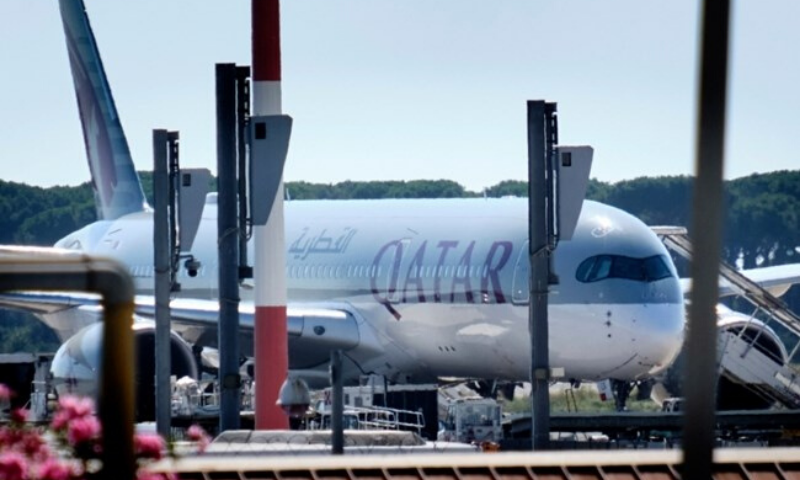
THE HAGUE: The UN’s top court on Tuesday backed Qatar in a bitter row with four Middle East nations that imposed an air blockade against Doha after accusing it of backing militants and Iran.
The decision by the International Court of Justice (ICJ) covers a key part of the acrimonious standoff that erupted three years ago pitting Bahrain, Egypt, Saudi Arabia and the United Arab Emirates against Qatar.
Qatar said after the decision that its rivals would “face justice”. “We welcome today’s decision by the ICJ that will see the blockading states finally face justice for violating international aviation rules,” Qatar Minister of Transport and Communications, Jassim Saif Ahmed al-Sulaiti, said in a statement.
The president of the ICJ, Abdulqawi Ahmed Yusuf, said The Hague-based court unanimously “rejects the appeal” by the rival states against a decision by the world civil aviation body in favour of Qatar over sovereign airspace.
The court also “holds that the International Civil Aviation Organisation (ICAO) has jurisdiction” in the case, by 15 judges to one, Yusuf said.
The ICAO in 2018 ruled it had the jurisdiction to handle a dispute brought by Qatar, which accused its neighbours of violating a convention that regulates the free passage of its passenger planes through foreign airspace.
But the four allies disagreed, saying the ICAO was not the right body to judge in the dispute and that its decision to do so was “manifestly flawed and in violation of fundamental principles of due process and the right to be heard”. They had asked the ICJ to declare the aviation body’s ruling “null and void and without effect”. The Gulf states of Saudi Arabia, Bahrain, the UAE and other allies abruptly severed ties with Qatar in June 2017, accusing the gas- and oil-rich country of backing militants and Iran.
They imposed wide-ranging punitive measures including banning Qatari planes from their airspace, closing Qatar’s only land border with Saudi Arabia and expelling Qatari citizens.
The countries justified the moves against the Gulf peninsula state saying it was their sovereign right to protect their national security.
Qatar fiercely rejected the claims that it had violated a series of agreements inked with its neighbours in 2013 and 2014 aimed at settling years of diplomatic rancour.
Last year the ICJ — set up in 1946 to rule in disputes between UN member states — rejected a request by the UAE to take special measures against Qatar, after Doha won a case at the ICJ in 2018 over alleged discrimination against its citizens.
Published in Dawn, July 15th, 2020