Human errors led to Ukrainian airliner’s downing, says Iran report

TEHRAN: Iran said that the misalignment of an air defence unit’s radar system was the key “human error” that led to the accidental downing of a Ukrainian passenger plane in January.
“A failure occurred due to a human error in following the procedure” for aligning the radar, causing a “107-degree error” in the system, the Iranian Civil Aviation Organisation (CAO) said in a report late on Saturday.
This error “initiated a hazard chain” that saw further mistakes committed in the minutes before the plane was shot down, said the CAO document, presented as a “factual report” and not as the final report on the accident investigation.
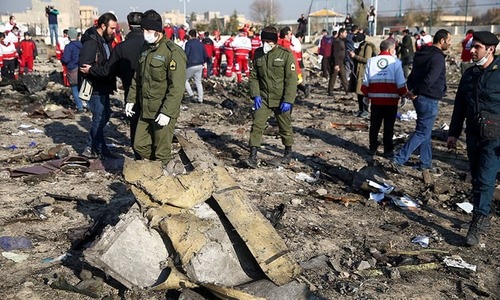
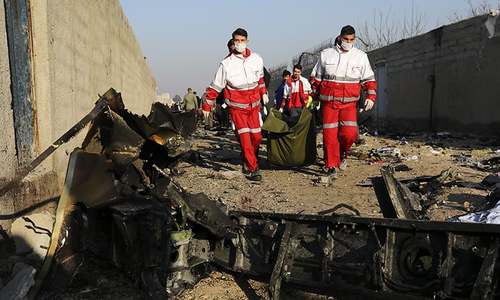
Flight 752, a Ukraine International Airlines jetliner, was struck by two missiles and crashed shortly after taking off from Tehran’s main airport on January 8, at a time of heightened US-Iranian tensions.
The Islamic republic admitted several days later that its forces accidentally shot down the Kiev-bound plane, killing all 176 people on board.
The majority of the passengers on the Boeing 737 were Iranians, with Canadians, Ukrainians, Afghans, Britons and Swedes also aboard.
The CAO said that, despite the erroneous information available to the radar system operator on the aircraft’s trajectory, he could have identified it as an airliner, but instead there was a “wrong identification”.
The report also noted that the first of the two missiles launched at the aircraft was fired by a defence unit operator who had acted “without receiving any response from the Coordination Centre” on which he depended.
The second missile was fired 30 seconds later, “by observing the continuity of (the) trajectory of the detected target”, the report added.
The CAO said there was a defect in the transmission to the defence units’ coordination centre of the data identified by the radar.
An Iranian general had said in January that many communications had been jammed that night.
Tehran’s air defences had been on high alert at the time the jet was shot down in case the US retaliated against Iranian strikes hours earlier on American troops stationed in Iraq.
Those strikes were carried out in response to the killing of a top Iranian general, Qassem Soleimani, in a US drone attack near Baghdad airport.
The aircraft tragedy sparked fierce criticism in Iran, especially after it took three days for the armed forces to admit having shot down the plane “by accident” after a missile operator mistook it for an enemy projectile.
Ottawa and Kiev have demanded for months that Iran, which does not have the technical means to decode the black boxes, send them abroad so their contents could be analysed.
Published in Dawn, July 13th, 2020