Pink ice in Italy’s Alps sparks algae probe


 0
0
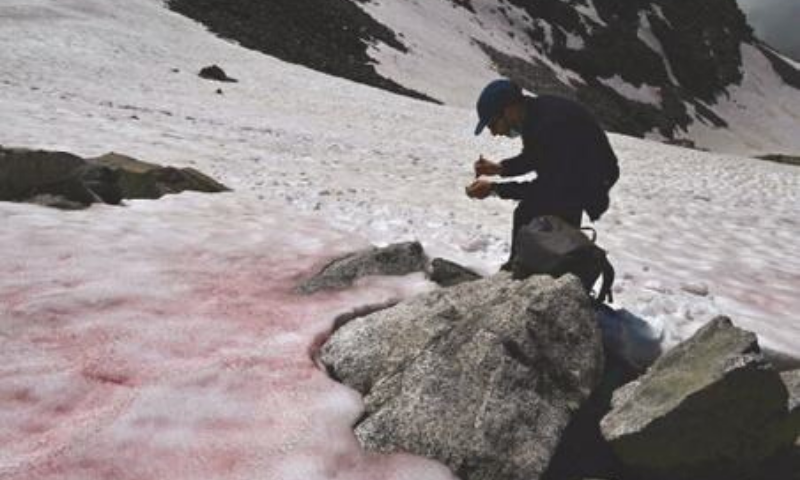
PASSO GAVIA: Scientists in Italy are investigating the mysterious appearance of pink glacial ice in the Alps, caused by algae that accelerate the effects of climate change.
There is debate about where the algae come from, but Biagio Di Mauro of Italy’s National Research Council said the pink snow observed on parts of the Presena glacier is likely caused by the same plant found in Greenland.
“The alga is not dangerous, it is a natural phenomenon that occurs during the spring and summer periods in the middle latitudes but also at the Poles,” said Di Mauro, who had previously studied the algae at the Morteratsch glacier in Switzerland.
The plant, known as Ancylonema nordenskioeldii, is present in Greenland’s so-called Dark Zone, where the ice is also melting.
Normally ice reflects more than 80 percent of the sun’s radiation back into the atmosphere, but as algae appear, they darken the ice so that it absorbs the heat and melts more quickly.
More algae appear as the ice melts more rapidly, giving them vital water and air and adding red hues to the white ice at the Passo Gavia, altitude 2,618 metres (8,590 feet).
“Everything that darkens the snow causes it to melt because it accelerates the absorption of radiation,” said Di Mauro.
“We are trying to quantify the effect of other phenomena besides the human one on the overheating of the Earth,” said Di Mauro, noting that the presence of hikers and ski lifts could also have an impact on the algae. Tourists at the glacier lament the impact of climate change.
“Overheating of the planet is a problem, the last thing we needed was algae,” said tourist Marta Durante.
Published in Dawn, July 6th, 2020