PM-appointed body calls for cut in policy rate, oil prices


ISLAMABAD: Members of a think tank constituted by the prime minister proposed on Saturday downward revision in the policy rate, passing on the benefit of reduced oil prices in the global market to the public, and provision of further liquidity for banks to boost the economy under strong recessionary headwinds.
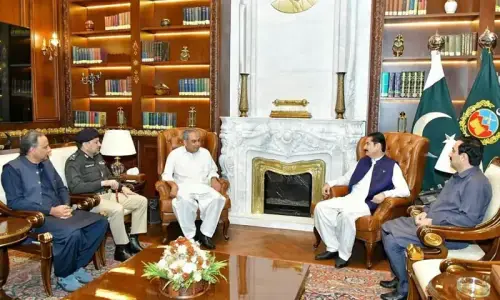
The think tank that was constituted recently by the prime minister to deliberate on the coronavirus-related economic downturn and mitigation of risks was discussing ways to boost the economy amid the crisis.
Adviser to the Prime Minister on Finance and Revenue Dr Abdul Hafeez Sheikh chaired the second meeting of the think tank, according to a press statement issued by the finance ministry.
The members of the group also reviewed and suggested ways to encourage remittances, financing in the agriculture sector and timely lifting of crops and vegetables produced by small farmers.
The forum discussed the need and scope for bailout package for large businesses and exporters apart from gauging the viability of reduction of GST on consumer goods from 17 per cent to 5pc, to kick-start consumer spending for the next two years.
Members of think tank also discuss ways to encourage remittances and financing in agriculture sector
During the proceedings, constraints of the Federal Board of Revenue (FBR) amid high revenue targets in a shrinking economy were highlighted by the finance secretary. A decision on this matter would be made after detailed consultation, said the ministry’s press release.
The think tank identified key areas for policy interventions, including monetary and banking sectors, fiscal matters and public finances, social safety nets, SMEs and large businesses, commodity prices, public health challenges besides the role of private sector and non-governmental organisations.
Dr Shaikh informed members of the think tank that there is potential for deferment of $1.8 billion debt for one year under the debt relief package announced by the G20 forum, whereas proceeds worth $1.4bn from the International Monetary Fund have already been received.
Economists in the think tank stressed the need for designing the Public Sector Development Programme (PSDP) so as to facilitate labour-intensive projects apart from crafting robust agriculture financing plans.
The need for public-private partnerships was elaborated upon that would create fiscal space in the public sector through off-balance sheet financing arrangements.
Well-known experts and economists like Shaukat Tareen, Dr Ishrat Husain, Dr Ijaz Nabi, Sultan Ali Allana, Arif Habib and Dr Waqar Masood are on the think tank. The finance secretary and Adviser to the PM on Commerce Razzak Dawood are also part of it.
Professionals in the group underlined the need for oil price hedging, scrutiny of power sector debt and creation of fiscal space through rescheduling of foreign and domestic debts.
The need for designing lending programmes for housing sector participants came under consideration including facilitation of end-users. The massive scope for mortgage-backed financing in the country was also highlighted.
Dr Shaikh took a lead in picking most urgent themes for proper policy deliberations and decisions. He said that Prime Minister Imran Khan might attend the next session of the group to give a boost to the forum which has been constituted to provide intellectual and professional insights to the ministry.
The finance adviser decided that interventions with the highest, medium and low impacts would be sorted out and aligned on short-, medium- and long-period basis so that most essential tasks are pushed up on priority basis, with proper funding and execution arrangements.
It was also decided that international think tanks would be engaged in processes so that robust interventions are designed to bring relief to economy and most deserving segments of public.
The progress relating to the ongoing cash disbursements under the Ehsaas programme was also shared, and the need for gathering reliable data on recently laid-off workers and timely cash transfers to the most vulnerable people was emphasised.
Published in Dawn, April 26th, 2020