India considers narrowing lockdown to coronavirus hotspots



India is considering plans to seal off coronavirus hotspots in Delhi, Mumbai and parts of the south while easing curbs elsewhere as a way out of a three-week lockdown that has caused deep economic distress, officials said on Wednesday.
The sweeping lockdown of India’s 1.3 billion people to prevent an epidemic of Covid-19, the respiratory disease caused by the virus, ends on April 14 and Prime Minister Narendra Modi is due to take a decision this week on whether to extend it.
Scenes of poor migrant workers and their families walking long distances on empty highways to their homes in the countryside have increased the pressure on Modi to re-open parts of Asia’s third largest economy.
Read: Poor Indians flee to villages as coronavirus measures take heavy toll
More than 80 per cent of the positive cases of the coronavirus have been traced to 62 districts — less than 10pc of India’s landmass — according to government data.
These are concentrated in the western state of Maharashtra, home to financial capital Mumbai, Delhi and the southern states of Tamil Nadu, Telangana and Kerala.
Many parts of the country have not reported a single case.
Such a skewed geographical spread strengthens the case for a more targeted approach under which the affected area and its neighbouring district will be cordoned off, health officials said.
“To manage coronavirus, we are working on a cluster containment strategy,” said Health Ministry joint secretary Lav Agarwal, leading the effort to tackle the outbreak.
'Bhilwara Model'
He said such measures were already in place in east Delhi, Agra and in the textile town of Bhilwara in western Rajasthan state which has now become a test case for a more targeted fight against the disease.
Under the “Bhilwara model”, which was adopted last month soon after about 30 people tested positive in the first big wave of infections, the town and its surrounding villages were tightly sealed with a virtual curfew in place.
People were not allowed even to step out of their homes to get essential stocks or medicines, instead they were asked to call helpline numbers for delivery of staples at their homes.
“It is a lockdown, within a lockdown,” said district information officer Gouri Kant.
So far, India has had 5,194 people infected with coronavirus of whom 149 have died, government data showed on Wednesday.
The small numbers, in comparison to large countries such as the United States, Italy and China have prompted questions from Modi’s critics about whether India has gone too far in shutting down its economy, throwing millions of those who depend on pay by the day out of work and onto the brink of poverty.
A senior government official, aware of internal discussions on the lockdown, said parts of the country that had not reported a single case of the coronavirus and where people were not in quarantine could lift the curbs.
“There are proposals that are on the table, if there is a partial lifting it will be done on the basis of safety assessment,” the official said.
But it was unlikely that schools, colleges, rail travel and religious gatherings would be allowed anywhere in the country, the official said.
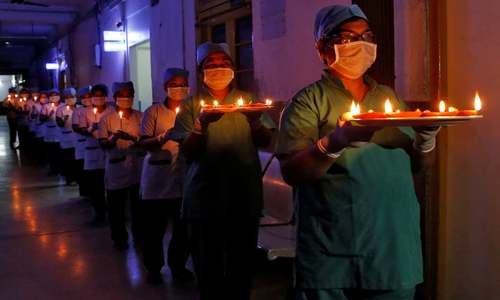
Read: Indians respond to Modi's call, light lamps to 'challenge darkness' of corona crisis
“If the lockdown has to be eased, it should be done in a graded manner in areas that are not hotspots. The hotspots should remain cordoned off,” Dr S K Sarin, who leads the Delhi government’s panel on Covid-19, said.