US report slams religion-based violence in India


WASHINGTON: Societal violence based on religion continued to be a serious concern in India during 2019 and Muslims and lower-caste Dalit groups continued to be the most vulnerable.
The US State Department’s annual Country Reports on Human Rights, released late Wednesday, noted 703 incidents of religious violence in India between 2016-17, in which 86 persons were killed and 2,321 injured. The statistics were provided by the Indian Ministry of Home Affairs but it did not include all incidents that occurred during this period.
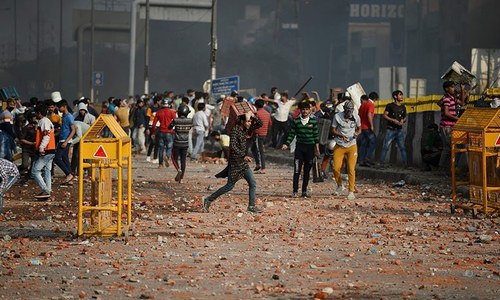
In a separate report on Thursday, The New York Times noted that the New Delhi police “concertedly moved against Muslims” and “actively helped Hindu mobs” that targeted Muslims and their homes during last month’s communal riots in the Indian capital.
Read: Indian police deliberately targeted Muslims during Delhi riots
At least 50 people were killed in these riots and over two-thirds of them were Muslims, the report added, noting that mosques were also burnt and vandalised and shops looted. At least 15 Hindus were killed as well in what the report described as India’s worst religious violence in decades.
The official US report, however, focused on human rights violations in India, which included arbitrary killings, forced disappearances, torture, rapes under police custody, arbitrary arrests and detentions, harsh and life-threatening prison conditions. Other violations included censorship, the use of libel laws to prosecute social media speech and site blocking.
The report noted that the government imposed restrictions on foreign funding of some NGOs, including those with views the government stated were not in the “national interest”, thereby curtailing the work of these NGOs.
The official US report pointed out that “a lack of accountability for misconduct persisted at all levels of government, contributing to widespread impunity”.
The report acknowledged that investigations and prosecutions of individual cases took place, but lax enforcement, a shortage of trained police officers, and an overburdened and under-resourced court system contributed to a small number of convictions.
The US State Department noted that out of 419,623 prisoners, about two-thirds were awaiting trial and “a disproportionate number of Muslims, Dalits, and Adivasis who made up 53 per cent of prisoners awaiting trial”.
The New York Times reported that several videos had surfaced since last month’s riots, showing Delhi police assaulting Muslims protesters, and urging Hindu mobs to join.
During the riots, NYT journalists heard police officials yelling to one another that they needed guns, not sticks, to confront the growing mobs. NYT pointed out that majority of those that were killed in the violent clashes were Muslims.
Published in Dawn, March 13th, 2020