Putin reveals he intends to stay in power beyond ’24


 7
7


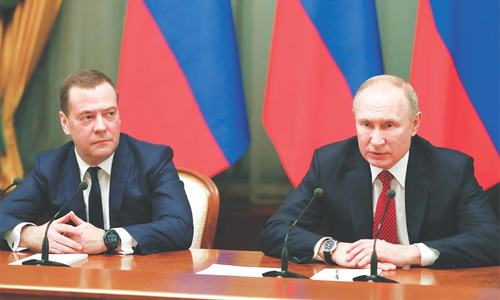
MOSCOW: Russian President Vladimir Putin laid out a path on Tuesday to staying in power beyond 2024, as lawmakers approved sweeping reforms to the constitution.
In a surprise address to the lower house State Duma, Putin said there could be a presidential “reset” allowing him to run after his current term expires.
“This would be possible ... if the constitutional court rules such an amendment would not go against (the constitution),” he said.
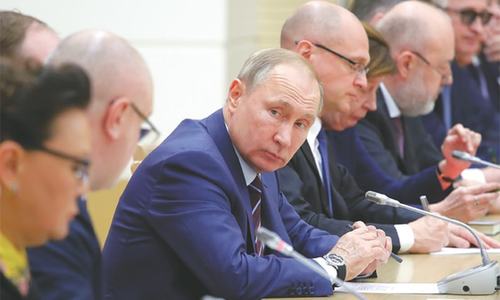
Putin appeared before the Duma after lawmakers proposed a series of amendments to a package of constitutional reforms he announced in January.
Among them was an amendment put forward by Valentina Tereshkova, an MP and Soviet-era cosmonaut who was the first woman in space, that would annul previous presidential terms.
This would allow 67-year-old Putin, who was first elected in 2000, to run again after his current six-year term expires, and potentially stay in power until 2036.
“These amendments are long overdue, they are needed, and I am sure they will be useful for society, for our citizens,” he told lawmakers. He said Russia needed evolutionary change, “because we have had enough of revolutions” while suggesting that the country may not yet be ready for a new leader.
“There will be a time when the highest power ... will not be tied to one specific person. But all of our previous history happened in this way, and of course, we cannot ignore this,” Putin said.
Lawmakers also proposed holding early parliamentary elections but Putin said that was not necessary and the amendment was withdrawn. He also rejected a call for a lifting of the overall two-term presidential limit.
Deputies then voted to approve the reforms in the key second reading, with 382 in favour, 44 abstentions and none against.
A third and final reading is due in the Duma on Wednesday, followed by approval in the upper house Federation Council and a public vote on the reforms planned for April 22.
Putin shocked Russia’s political establishment by announcing the package of reforms in January, the first major changes to the country’s basic law since 1993.
The political changes will also give parliament the power to choose the government and increase the role of the State Council, an advisory body.
Other proposals aim at boosting living standards, including a guaranteed minimum wage and state pensions adjusted to inflation.
And — in line with Putin’s strongly conservative views — the reforms would enshrine a mention of Russians’ “faith in God” and spell out that marriage is a heterosexual union.
Russia’s opposition, including Putin’s most prominent critic Alexei Navalny, has denounced the proposals as an effort to make him “president for life”.
“Interesting how things turn out,” Navalny said in a tweet after Putin’s speech.
“Putin has been in power for 20 years but he’s going to run for the first time.” More than 20,000 protesters took part in a rally on February 29 calling on Putin not to hold on to power and opposition groups on Tuesday quickly put in requests for permission for more demonstrations.
But so far there has not been an upswell of opposition to the reforms, with polls showing many Russian are confused about what the constitutional proposals entail.
Observers had previously suggested that Putin could be looking to stay on in a behind-the-scenes role after 2024 as head of another state body.
But Dmitry Trenin, director of the Carnegie Moscow Center, said Tuesday’s events made it clear Putin wanted to remain in charge.
“It looks that after playing with ideas of State Council and Security Council Putin has finally decided in favour of running again in 2024,” Trenin said on Twitter.
Putin was re-elected to a fifth term in 2018 but his approval ratings have been falling as Russia’s economy struggles under the weight of Western sanctions and living standards fall.
The economy is set for more turbulence in the coming weeks and potentially months after oil prices crashed following the collapse of the production limits deal between Russia and Saudi Arabia. The value of the ruble and Russian stock exchanges have since tumbled.
Published in Dawn, March 11th, 2020