Third Sufi festival draws to an end at Sindh Museum


 0
0
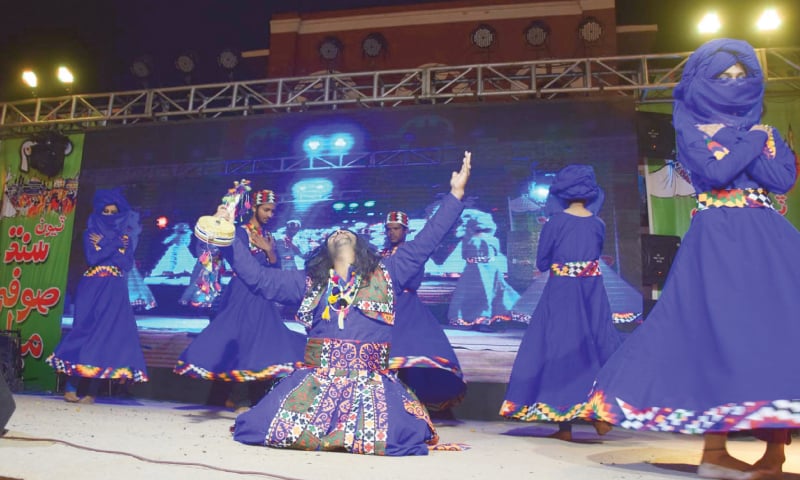

HYDERABAD: The Tiyoon Sufi Melo (Third Sufi festival) concluded at the Sindh Museum on Sunday evening with a session on Makhdoom Bilawal.
Titled ‘Makhdoom Bilawal – Sindh’s brave Sufi’ was moderated by Dr Arfana Mallah, who put different questions to speakers including Prof Qalandar Shah Lakhiyari.
Lakhiyari described Makhdoom Bilawal as ‘Imam of Sindh’s sufis’ because he challenged tyrants’ oppression and waged a practical struggle against them. “An intelligent man always has a direct and strong influence of poetry, which is an important tool to convey a message to the masses easily and in an effective way. Poetry always reflects people’s sentiments,” he said.
Noor Ahmed Jinjhi said that He said that Makhdoom Bilawal stood for Sindh’s sovereignty. His ideology was academic and effective, he observed. He said poetry played a major and important role in projecting Sindh’s Sufism. The Makhdoom was not a conventional sufi, he said, and remarked that Sindh was still paying for the wounds of destructions caused by Arghuns.
Munawwar Mahesar called for more work on the life of Makhdoom Bilawal, and announced that a conference on the great Sufi would be convened. He noted that Sufis had nationalistic leaning and positive thoughts. A true Sufi would always challenge tyranny, he said.
“In our society, religion is used as a tool of suppression,” he remarked.
Dr Arfana Mallah said that some work on Makhdoom Bilawal was found in the Samma period. She called for more research on his life, and said justice should be done to him by undertaking the job.
At another session titled wahdul wajood, was moderated by Shabnam Gul of the Sindhi Language Authority.
One of the participants, Arbab Naik Mohammad, said that the true spirit of mysticism was taken away by those who would use shrines as a source of their business. He observed that colours of mysticism were found in Punjab as well, and pointed out that Imam Rabbani was a known poet who talked about wahdatul wajood and wahduatul shahood immensely.
Prof Atta Billu said that for common man, Sufisim was all about saffron colour, dance and raag but Sufism was not restricted to these things alone as it had a huge knowledge in itself. “Characters are born with different faces and this process will continue as long as the world exists,” he said.
Ragis including Resham Parveen, Faqir Riaz Abbasi, Ashiq Hussain Bhatti, Zafar Ali, Mahboob Ali Jogi, Irshad Ali Shah and others performed at the festival. A stage drama on Bhitai’s sur titled Sorath Rai Diyach was also staged with Murkh Shah acting as Sorath and Israr Leghari as Rai Diyach.
Published in Dawn, December 9th, 2019