US lawmakers take up held Kashmir issue, again

WASHINGTON: “We have concerns about Kashmir, and we are watching the situation very closely,” says Eliot L. Engel, Chairman of the House Foreign Affairs Committee, as another congressional panel reviews the consequences of India’s decision to revoke the valley’s special status.
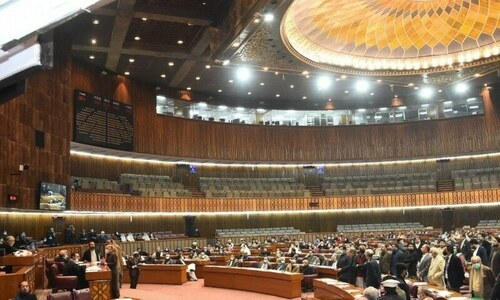
On Thursday, the Congressional Tom Lantos Human Rights Commission was holding a hearing to “examine the human rights situation in the former state of Jammu and Kashmir in India in historical and national context.”
But that’s not enough for Congresswoman Pramila Jayapal, who wants a House resolution to send a clear message to India that forces New Delhi to reconsider its policies in held Kashmir. Jayapal is the first woman of Indian descent to be elected to the US House of Representatives.
Another US lawmaker, Senator Chris Van Hollen, backs a recent amendment to a Senate appropriations bill that mentioned the restrictions in held Jammu and Kashmir.
At a gathering at the Islamic centre in Howard County, Maryland, on Tuesday, Senator Van Hollen urged the Indian government to “abide by international human rights laws and uphold democratic freedoms” for the people of Kashmiri.
Senator Van Hollen, who recently visited India, Pakistan and Afghanistan, also criticised the Indian government for refusing to let him visit Jammu and Kashmir by the Indian government. Speaking to a group of Kashmiri Americans at the residence of a Pakistani physician, Dr Asif Mahmood, Congressman Engel also expressed concern at the situation in Kashmir and assured the people of Kashmir that their basic human rights will be protected.
Last month, Dr Mahmood helped arrange a congressional hearing on Kashmir, which was described by the Indian media as “the most critical examination that any Indian action has received in a panel of US House of Representatives since the 1998 nuclear tests.”
The Congressional Commission’s Thursday hearing is equally important for highlighting the Kashmir cause and exposing India’s atrocities in the occupied valley. So is Congresswoman Jayapal’s effort to move a House resolution to “send a clear message to New Delhi” on Kashmir.
The Indian media, while commenting on her effort, compared her to a Republican congressman, Dan Burton, who “constantly raked India over the coals on Punjab and Kashmir,” wrote a major Indian newspaper, The Economic Times.
The newspaper’s warned that Ms Jayapal’s move could embarrass India like what Congresswoman Ilhan Omar did last month during the hearing on South Asia, when she openly challenged New Delhi’s claims on Kashmir.
In a statement to the media, the Lantos Commission noted that India’s decision to change the legal status of the Muslim-majority region of Jammu and Kashmir, announced in August and effective as of October 31, 2019, “has attracted intense attention due to persistent reports of human rights violations.” It also noted the crackdown on freedom of expression; the arbitrary “preventive” detention of hundreds of politicians, lawyers, journalists, and other civil society figures and related fears of enforced disappearance; and the use of excessive force against protesters.
The commission noted that the increased militarization of the region, and the economic and social consequences of India actions had also provoked widespread concern. “Although India’s decision was sudden, the situation in Jammu and Kashmir has been of concern for years,” it added.
The statement also mentioned a 2018 report by the Office of the UN High Commissioner for Human Rights (OHCHR), which documented human rights violations in the region and issued recommendations on a wide range of issues including civilian killings, deaths during security operations, blanket restrictions on journalists and independent observers, misuse of anti-terrorism legislation, and protection of religious minorities.
The commission also referred to a follow-up OHCHR report in July 2019, which found little improvement and reiterated the “urgent need to address past and ongoing human rights violations and to deliver justice for all people in Kashmir.”
The commission said that its “witnesses will examine the human rights situation in Jammu and Kashmir in the context of the region’s history and larger patterns of rights violations in India and Pakistan and will offer recommendations for action by Congress.”
Published in Dawn, November 14th, 2019