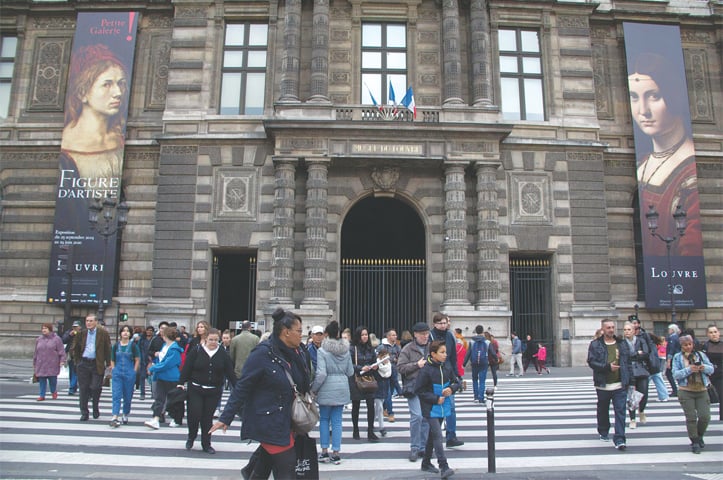
PARIS: Leonardo da Vinci is the star in a blockbuster retrospective that opened on Thursday at the Louvre museum in Paris to mark 500 years since the death of the Renaissance master.
Some 240,000 people have already reserved their place in line for the exhibition, the biggest one ever organised to showcase the Tuscan polymath’s indelible contributions to humanity — with an emphasis on his painting.
A decade in the planning, the show simply titled “Leonardo da Vinci” groups 162 works, including 24 drawings loaned by Queen Elizabeth II of Britain from the Royal Collection.
The British Museum, the Hermitage of Saint Petersburg and the Vatican have also contributed, as well as, of course, Italy — after a sometimes acrimonious tug-of-war between Rome and Paris over the loans.
The exhibition in the Hall Napoleon, which runs until Feb 24, features 10 of the fewer than 20 paintings definitively attributed to the Renaissance master, as well as drawings, manuscripts, sculptures and other objets d’art.
Visitors follow a timeline of the master’s peripatetic career under the tutelage of dukes, princes and kings, from Florence to Milan, Venice and Rome, and finally France, where he spent the last three years of his life.
He died in the historic town of Amboise in the Loire Valley on May 2, 1519.
The exhibition curated by the Louvre’s Vincent Delieuvin and Louis Frank, the heads of the museum’s painting and graphic arts departments, includes infrared reflectographs that offer an insight into the master painter’s techniques.
“Nearly everything is achieved with very fine layers of paint — glazing,” Delieuvin said. “That allowed him... to give the painting a vibration,” he said.
Two standout works are missing from the show, starting with the Mona Lisa.
Organisers decided the world’s most famous painting should remain in the Louvre’s Salle des Etats — its normal home — to help avoid overcrowding. By itself, the masterpiece attracts nearly 30,000 people a day.
The Mona Lisa’s ineffable smile however beguiles visitors in a virtual reality experience at the end of the show.
“It’s a pretty extraordinary experience,” said Lorenz Baumer, removing his headset after viewing the film. “You have the impression of being inside the head of this man... and encountering Mona Lisa through what she has to tell us,” said Baumer, a jeweller.
The other notable no-show is the Salvator Mundi, the work that became the most expensive painting ever sold when it fetched $450 million at a Christie’s auction in 2017.
Mystery now surrounds the painting — whose authenticity is disputed by some experts — as it has not been seen in public ever since the record-shattering sale.
The Louvre has said the museum’s request to borrow the work is still pending, but a last-minute appearance would be a stunning surprise.
Published in Dawn, October 25th, 2019