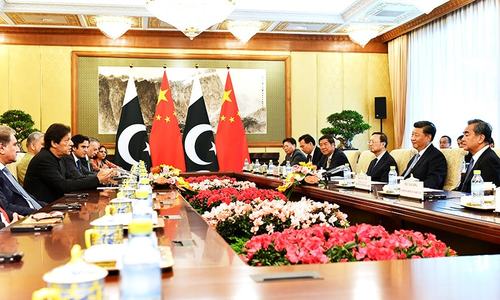
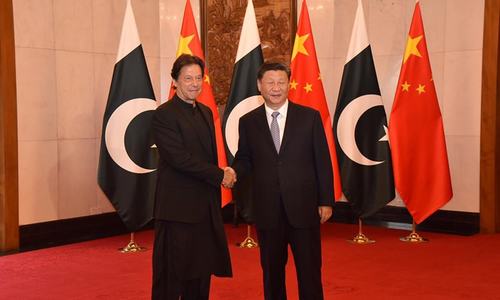
THE prime minister’s visit to China has reaffirmed the traditionally close ties between Islamabad and Beijing, with the highest echelons of power from both sides exchanging views on political, economic and military issues.
Of course, China has long been admired by Pakistani leaders for its transformation from a backward, isolated state into a modern economic powerhouse. But though there are many things we in Pakistan can learn from China’s impressive rise since the founding of the People’s Republic in 1949, there are also lessons on what to avoid, especially if the ruling establishment wants to stick to the confines of the democratic system.
During his Beijing visit, Prime Minister Imran Khan has been quoted as saying that this country would do well to follow China’s example and put “500 corrupt people in Pakistan in jail”.
The statement seems to be a milder version of what Mr Khan’s cabinet colleague Minister for Water Resources Faisal Vawda said not too long ago, that 5,000 people should be hanged to secure the future of 220m.
While corruption is indeed a bane that has been eating away at Pakistan’s vitals for decades, the aforementioned comments reveal a disturbing mentality.
Instead of filling the jails with the ‘corrupt’, or worse, hanging people in the streets, the leadership of the country should be talking about creating a viable system that punishes unscrupulous individuals in a transparent manner, and eliminates the scourge at the grass roots.
There are many things in the Chinese model that are worthy of emulation. But frequent executions and purges — the horrors of the Cultural Revolution should not be forgotten — should not be among them.
However, there can be little argument with the fact that over the past seven decades, China has made huge strides in many fields.
Before the communist revolution, barely 15pc to 20pc of the Chinese people were literate; today that figure is over 90pc. Moreover, as per the World Bank, over 850m people have been lifted out of extreme poverty in China.
These are no mean achievements and show a determination on the part of the Chinese leadership and people to change the course of their country’s destiny. This tenacity must be appreciated.
Also, after the fall of the USSR, Beijing has played a role in bringing an element of multipolarity to global politics to prevent the US from becoming a global hegemon.
To top it all, China has stood by Pakistan in difficult times, and CPEC is an example of this time-tested friendship.
For Pakistan, there is much to learn from China — perhaps the primary lesson should be that progress can only come through discipline, economic stability and socioeconomic uplift.
While the more violent episodes of modern Chinese history should not be replicated, the relationship between Islamabad and Beijing can mature and improve in a variety of sectors.
Published in Dawn, October 10th, 2019