0
0

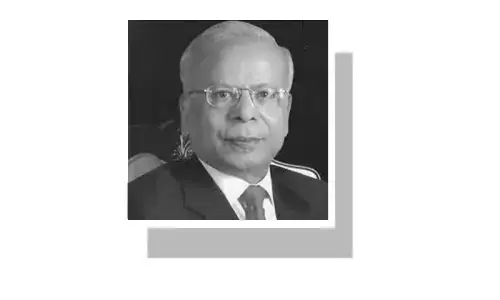
LARKANA: A ceremony to honour Abdul Majid Bhurgari, the creator of Sindhi language computing system and developer of Sindhi Unicode fonts on electronic devices and computers, was organised by the Arts Council here in its Bhitai Adabi Hall on Monday night.
Award was conferred on Mr Bhurgari in recognition of his unique services for the Sindhi language.
On the occasion a symposium on ‘Modern construction of Sindhi language and its future’ was also held in which along with Mr Bhurgari, Amar Fayaz Buriro, IT specialist, language engineer and computational linguist of the Sindhi language, also participated and discussed many important points related to modernising construction and computing of the Sindhi language.
Replying to a question of the mediator of the symposium, Abdul Majid Bhurgari said: “I have no degree in computer science, but my interest in it brought me in this field.”
He said that he felt the need for introducing the Sindhi alphabet to computer.
“Living in Seattle (USA) I contacted Microsoft management and got their support for Unicode for the Sindhi language.”
Unicode is a computing industry standard for the consistent encoding, representation, and handling of text expressed in most of the world’s writing systems.
He said since the year 2000 the Sindhi language on computer and on other devices and its publishing had become possible.
He stressed that Sindhi should be written in its present alphabet in computer instead of Roman or any other script.
Amar Fayaz Buriro eulogised the services of Abdul Majid Bhurgari and said that he had levelled the ground for the Sindhi language computing.
He said Mr Bhurgari laid the foundation of Sindhi language writing in computers and now the work in that context shall be expanded.
The Sindh government had rightly recognised the services of Mr Bhurgari by establishing Abdul Majid Bhurgari Institute of Language Engineering”, he added.
Speaking on the occasion, Commissioner of Larkana division and chairman of Arts Council Larkana Saleem Raza Khuhro said that Mr Bhurgari had done a unique work to strengthen the Sindhi language through computing and introducing its Sindhi alphabet on Unicode.
However, he added that writing Sindhi in the Roman alphabet should not be discouraged.
“When Urdu is widely written in Roman and text messaging on WhatsApp has got official acceptability than what is bad if Sindh is also written in Roman alphabet.”
He said: “If we want to survive, we have to move ahead with technology. Many things and manual works which we experience today may not exist manually after some years because they might be replaced with technology. The artificial intelligence would revolutionise life in future.”
A large number of people from cross section of the population attended the programme.
Prominent among them were Abdul Razzaq Soomro, Akhtar Ali Janwari, Dr Amanullah Jokhio, Abdul Hamid Bhurgari, Professor Irshad Ali Solangi, Dr Bashir Ahmed Shaad, Professor Mukhtiar Samo, and Dr Ahsan Danish.
Abdul Nabi Saryo and Rizwan Gul conducted the programme.
Published in Dawn, September 18th, 2019