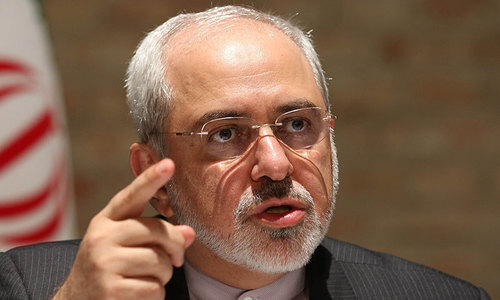
Iran's top diplomat walks back from remark on missile talks


Iran's foreign minister said on Wednesday that the country has no choice but to manufacture missiles for defense purposes — comments that reflect more backtracking after a remark by the top diplomat suggesting the missiles could be up for negotiations.
Mohammad Javad Zarif said in an interview with NBC News that aired earlier this week that if the United States wants to talk about Iran's missiles, it needs “first to stop selling all these weapons, including missiles, to our region.”
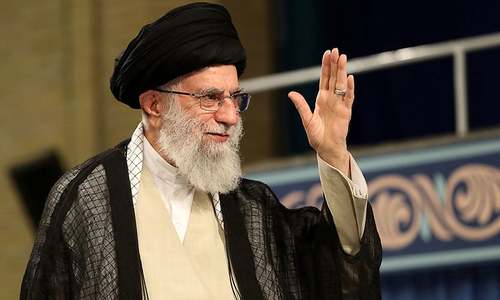
Iran has long rejected negotiations over its ballistic missile programme, which remains under the control of the Iranian paramilitary Revolutionary Guard that answers only to Supreme Leader Ayatollah Ali Khamenei.
The foreign minister's remarks suggested a possible opening for talks as tensions remain high between Tehran and Washington. But the Iranian mission to the United Nations promptly called Zarif's suggestion purely “hypothetical” and said the Iranian missiles were “absolutely and under no condition negotiable with anyone or any country, period.”
In Tehran, the foreign ministry's spokesman, Abbas Mousavi, tweeted late on Tuesday that Zarif's comments meant to challenge Washington and “threw the ball into the US court while challenging America's arms sales” to its Mideast allies.
Zarif himself on Wednesday backpedaled on the missiles issue, saying Iran has no choice but to manufacture the missiles for its own defence.
He cited the 1980s Iran-Iraq war and tweeted that, “For eight years, Saddam [Hussain] showered our cities with missiles and bombs provided by the East and West. Meanwhile, no one sold Iran any means of defence. We had no choice but building our own. Now they complain.”
“Instead of skirting the issue, the US must end arms sales to Saddam's reincarnations,” Zarif added.
Tensions between Tehran and Washington have sharply escalated since US President Donald Trump unilaterally last year withdrew America from the nuclear deal between Tehran and world powers and re-imposed sanctions on Iran, sending its economy into freefall.
America has also rushed thousands of additional troops, an aircraft carrier, nuclear-capable B-52 bombers and advanced fighter jets to the Mideast amid unspecified threats from Iran.
Mysterious oil tanker blasts near the Strait of Hormuz, attacks by Iranian-backed rebels in Yemen on Saudi Arabia and Iran's shooting down of a US military drone in the past months further raised fears of a wider conflict engulfing a region crucial to global energy supplies.
Recently, British authorities intercepted the Iranian supertanker Grace 1, carrying 2.1 million barrels of light crude oil, and seized it with the help of British Royal Marines off the coast of Gibraltar.
They believed it to be violating European Union sanctions by carrying a shipment of Iranian crude oil to Syria. Spanish authorities said the seizure came at the request of the US.
This is not the only issue between Iran and Britain. Nazanin Zaghari-Ratcliffe, a British-Iranian woman imprisoned in Iran following her arrest in April 2016 on charges of plotting against the Iranian government, has been transferred to a hospital mental health facility, her husband said on Wednesday.
Her family denies the allegations against her. Her husband, Richard Ratcliffe, said in Britain that his wife has been moved to the mental health ward of Imam Khomeini hospital under the control of the Revolutionary Guard.
“Hopefully her transfer to the hospital means that she is getting treatment and care, despite my distrust of just what pressures can happen behind closed doors. It is unnerving when we don't know what is going on,” he said.
Iran does not recognise dual nationality. British officials have urged Iranian officials to let her have contact with her family.