Sudan protesters, generals trade blame for bloodshed at rally


KHARTOUM: Sudan’s protest leaders and ruling generals traded blame on Monday for deadly new violence as three blood-stained bodies were found a day after the first mass rallies since a crackdown on demonstrators.
Read: Tens of thousands protest army rule in Sudan
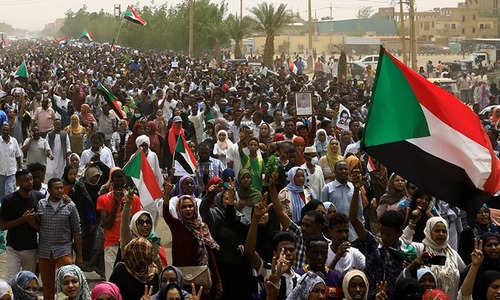
State media reported that seven people were killed on Sunday when tens of thousands rallied to demand a civilian government, while medics linked to the protest movement said five protesters had been killed.
Protesters have been calling for the departure of generals who seized power following the April ouster of longtime ruler Omar al-Bashir.
Sunday’s “million man” march had been seen as a test for protest organisers after a June 3 raid on a Khartoum protest camp left dozens dead and a subsequent internet blackout curbed their ability to mobilise support.
But that did not prevent vast crowds of men and women, chanting slogans demanding “civilian rule”, flooding the streets of Khartoum, twin city Omdurman and other towns and cities, correspondents and witnesses reported.
Security forces were deployed en masse in key Khartoum squares, firing tear gas in several areas including at protesters attempting to reach the capital’s residential palace.
The official SUNA news agency quoted a health ministry official as saying seven people were killed, without giving details, and another 181 wounded, including 27 by gunfire.
It also said a further 10 security personnel were wounded, including three from the feared paramilitary Rapid Support Forces (RSF), shot with “live ammunition”.
A doctors’ committee linked to the protest movement said five protesters were killed on Sunday, four of them in Omdurman, across the Nile from Khartoum.
It also said several more were seriously wounded by gunshots fired by “military council militias,” a term used by protesters for the RSF.
On Monday, three blood-stained bodies were found lying in an area of Omdurman that had seen protests the previous day, a correspondent reported.
Their identities were not immediately clear, but the doctors committee later described them as “martyrs”.
Crowds of people gathered around the bodies, chanting “Just Fall, Just Fall,” another catchcry of the protest movement that has rocked Sudan since demonstrations first erupted against Bashir in December.
The correspondent said riot police later dispersed the crowd with tear gas.
Protest leaders blamed the generals for Sunday’s bloodshed.
“The military council is completely responsible for these lives lost,” prominent protest leader Mohamed Naji al-Assam said in a video posted on his Facebook page.
“Peaceful Sudanese protesters are exposed to excessive violence, live bullets and beatings,” he said.
But, he added, “the Sudanese have proven that they will not back down”.
The generals in turn blamed the protest movement, the Alliance for Freedom and Change, for Sunday’s violence.
“Freedom and Change...incited protesters to go toward the republican palace (prompting) police forces to use tear gas to disperse protesters,” General Jamal Omer said in a video posted on the ruling military council’s Facebook page.
“Freedom and Change bears the entire responsibility for these violations and the casualties among regular forces and citizens.” Tension remains high between the protest leaders and generals since the June 3 raid, when armed men in military fatigues shot demonstrators who had camped for weeks outside army headquarters.
According to the doctors’ committee, at least 136 people have been killed since the raid, including more than 100 on the day of the crackdown.
Health ministry figures show 68 people have died nationwide since the raid, including those killed on Sunday.
The generals insist it did not order the dispersal of the sit-in, but acknowledge “excesses” after orders were given to purge a nearby area allegedly a notorious hotspot for drug dealers.
The raid came after talks between the protesters and generals collapsed over installing civilian rule.
Ethiopia and the African Union have been mediating between the two sides but have yet to achieve a breakthrough.
France has backed Ethiopia-African Union efforts as it urged a swift solution to the crisis in Sudan.
The French foreign ministry called for the formation of a civilian-led government based on the Ethiopian-African Union blueprint.
Published in Dawn, July 2nd, 2019