0
0
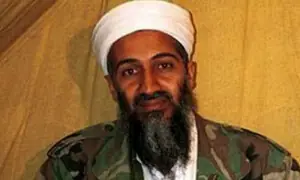
NEW YORK / WASHINGTON, July 22: President General Pervez Musharraf has said he will prefer that Osama bin Laden is captured by the American forces in Afghanistan and declared that agents from other countries will not be allowed to enter Pakistan to capture the Al Qaeda leader. “We hope he’s found in Afghanistan by the Americans,” the president told ABC News in an interview on Wednesday, adding later, “… I would much prefer that somebody else handled him.”
When referred to a recent statement by CIA Chief Porte Goss that the United States had an excellent idea where Osama was, but would have a difficult time bringing him to justice because of sovereignty issues, President Musharraf said that he would not let other countries into Pakistan, if Al Qaeda leader was indeed there.
“We are capable of doing it,” he added. “If we get intelligence, we will do it ourselves.”
Asked whether Pakistan would turn Osama over to the United States if he was found in Pakistan, President Musharraf said he would “have to see what happens”.
When his attention was drawn to recent polls showing that some 50 per cent of Pakistanis supported Osama, President Musharraf rejected the idea that his countrymen supported terrorism.
He said it’s not terrorism his people supported, but they were against US policies.
“I think exactly that they are opposed to US policy, and they see him (Osama) as a person who is fighting the policies of United States,” he said. “But if you were to take a poll on are they in favour of terrorist attacks anywhere in the world like 9/11 or London, I am reasonably sure the poll will indicate otherwise.”
The president said Americans had a distorted sense of Pakistan, seeing it a nation full of extremists.
“The vast majority is moderate,” he said. “ … the US must understand that the vast majority here are moderate. If they were extremists I wouldn’t be popular here.”
In reply to a question about London bombings, Gen Musharraf rejected the suggestion that Pakistan was an incubator for terrorism and said these attacks showed Britain had its own problems with extremists.
After recent bombings on London’s transport system, British Prime Minister Tony Blair turned his attention to Pakistan, calling on Gen Musharraf to crack down on terrorist elements. President Musharraf, however, said that blame for the bombings lay elsewhere. “The problem is not in Pakistan; the problem is in England, let that be clear,” he said. He said England had been slow to react to growing extremism within its borders, including not acting upon a fatwa he said had been issued against him. “What did England do about this [the fatwa]?” he asked. “Have they banned these organizations? Have they arrested the person who has done that? No, nothing. Nothing. In the name of human rights, in the name of liberty, human liberty, freedom of speech, this is going on. So why blame us? Please set your own house in order. Everyone has to do something.” Gen Musharraf said there was “no credible intelligence” tying the London bombers to Pakistan, despite reports that three of the four had spent time there. The London bombers were Britons, he said. “The problem is not in Pakistan but in England,” he said. “Their hatred has been spread in London and nobody has moved against them. So why are they blaming Pakistan?”
MALAYSIAN DELEGATION: Meanwhile, the president underlined that terrorism must be rejected in all its forms and manifestations and the international community, including the Muslim world, needed to take effective measures to combat extremism and terrorism in a comprehensive manner.
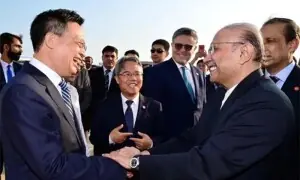
He was speaking to a parliamentary delegation from Malaysia that, led by the Speaker of the House of Representatives Tan Sri Dato Sri Diraja Ramli bin Ngah Talib, called on him in Islamabad on Friday. National Assembly Speaker Chaudhry Amir Hussain was present on the occasion.
Gen Musharraf said that the Organization of Islamic Conference should be revitalized and restructured to effectively respond to the challenges faced by the Muslim world.
On Pakistan-Malaysia bilateral relations, he said the two countries enjoyed excellent relations and shared similar views on international issues of common interest and on challenges faced by the Muslim Ummah.
He emphasized the need for enhancing economic and commercial ties between Pakistan and Malaysia.
Expressing satisfaction over the interest shown by some Malaysian companies in the infrastructure and housing projects in Pakistan, the president encouraged the business community from Malaysia to explore mutually beneficial investment opportunities in Pakistan.