Supreme Court reserves ruling in school fees case


 10
10


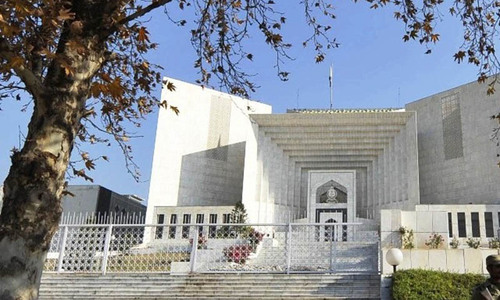
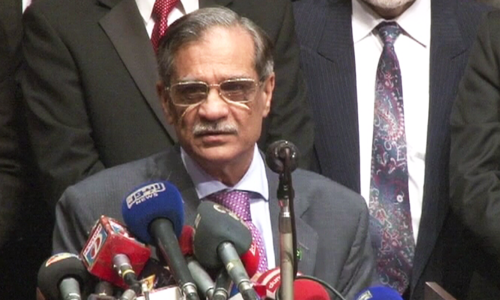
ISLAMABAD: The Supreme Court reserved its ruling in the school fees case after a daylong hearing on Thursday, with Chief Justice Asif Saeed Khosa stressing the need for spending more on teachers for quality education in the country.
A three-judge SC bench was seized with a number of appeals against the cap on school fee introduced by the Sindh and Punjab governments, with not more than five per cent increase in fee for initial three years in the case of Sindh.
Read: SC orders 20pc reduction in private school fees over Rs5,000
The chief justice quoted Lord Macaulay as having once stated that if he got good teachers, he would return a good nation. The chief justice also shared the experience of how the judiciary was getting the best talent after introducing a good package for district judges. “This is also evident from the fact that people instead of applying to central superior services are now turning towards the judiciary,” he observed.
During the hearing, Justice Faisal Arab observed that what generated the instant litigation before the Supreme Court was a phenomenal increase in fees by private schools at the start of every academic year, which forced the regulator to jump in.
Chief Justice Khosa stresses need for spending more on teachers for quality education
Justice Ijaz-ul-Ahsan observed that the parents were aggrieved with the level of fees the private schools were charging but not bothered about what profits these schools were making.
In some cases, according to the Auditor General’s report on private schools, Justice Ahsan observed, the expenses shown by the schools were in fact designed for tax management and as a result parents suffered ultimately.
The SC bench also remanded back a number of cases relating to the Islamabad High Court, the Peshawar High Court and the Balochistan High Court to the respective courts for appropriate proceedings in accordance with the judgement the apex court will render in the matter.
The Supreme Court also disposed of a contempt charge initiated against two schools — Headstart School System (Pvt) Ltd and Ecole des Lumieres School of Light — for allegedly circulating highly derogatory letters addressed to parents and guardians.
On Feb11, the apex court had issued notices to the owners/directors/chief executives of these schools to appear before the court and explain why proceedings for contempt of court should not be initiated against them. The court had taken exception to describing as draconian the court’s Dec 13, 2018 interim order of slashing school fees by 20 per cent.
However, while discharging the contempt notice against Headstart, the chief justice observed that the court had gone through the letter and found that though the language used by the respondent could have been better, the fact remained that the school’s director Nazneez Murtaza had shown remorse and furnished unqualified apology with an assurance that she would always act to uphold the dignity of the court and the institution of the judiciary.
Against this backdrop, the chief justice observed, no interference was called for and, therefore, “we accept the apology and thus the notice issued to the school is withdrawn and recalled”.
“People get emotional but we should not,” the chief justice observed.
Advocate General for Sindh Salman Talibuddin argued that it was a misnomer to argue on part of the private schools that the five per cent capping would in fact regulate the profits of the schools, adding that it was the schools which determined their profit margins while applying before the regulators for getting approval of their fee structure. “Thus this is wrong to say that the regulation will stifle them,” he contended.
Senior counsel Faisal Siddiqui, representing some parents, regretted that the private schools, instead of justifying exorbitant fees they received from parents, were hiding behind the schools being run by trust or on a non-profit basis in their attempt to strike down the fee cap.
Senior counsel Khawaja Ahmed Hussain, representing a number of private schools, argued that the cap on fee was unconstitutional as it interfered in the fundamental rights of such schools. “The legacy of such capping or restrictions on the private schools will make children and their parents suffer since the schools will considerably reduce the quality of education as well as the facilities being offered by them and thus the students will not be able to compete internationally,” he feared.
The chief justice dispelled the impression as if the court was averse to the idea of doing business and said it was only concerned with the legal and constitutional issues involved in the matter. If anything was illegal then it became the domain of the court, he said. “You can make good fortune and if you are making good money, so be it,” observed the chief justice.
Published in Dawn, May 10th, 2019