Oil falls near 2pc as US-China trade war intensifies


NEW YORK: Oil prices slipped nearly 2 per cent on Tuesday, on track to fall to their lowest levels in over a month as renewed doubts over US-China trade talks stoked concerns over global growth and demand even though US sanctions on Iran and Venezuela tightened supply and helped stem losses.
Brent futures were down $1.36, or 1.9pc, at $69.88 a barrel by 1439 GMT, while US West Texas Intermediate crude was down $1.14, or 1.8pc, at $61.11 per barrel.
If the futures close at their current levels, it would be the lowest settle for Brent since April 4 and WTI since March 29.
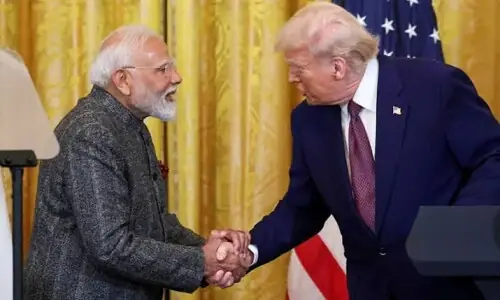
US President Donald Trump on Sunday said he would raise tariffs on $200 billion worth of Chinese goods from 10-25pc by Friday. The comments dragged on both Asian and US stock markets.
“An escalation in the US-China trade war has brought oil prices under renewed pressure,” said Abhishek Kumar, head of analytics at Interfax Energy in London.
“The spat has reinvigorated demand-side concerns, given that the conflict has been adversely impacting prospects for global economic growth.” On the supply side, oil markets remain tense with the United States tightening sanctions on Iranian oil exports and plans to bulk up its forces in the world’s top oil-exporting region.
US officials announced on Sunday that the movement of an aircraft carrier strike group and a bomber task force towards the Middle East was meant to counter “credible threats,” but Tehran dismissed the move as “psychological warfare.”
“The threat of military action with Iran appears to have heightened ... This has allowed the oil complex to gain some footing after WTI has been beaten down during the past couple of weeks by some unexpectedly large crude supply increases,” Jim Ritterbusch, president of Ritterbusch and Associates in Chicago, said in a report.
US sanctions have already halved Iranian crude exports over the past year to less than 1 million barrels per day (bpd), with shipments to customers expected to drop to as low as 500,000 bpd in May as sanctions tighten.
US Energy Secretary Rick Perry said on Tuesday that Saudi Arabia was increasing its oil production to meet needs arising from sanctions on Iran.
Bank of America Merrill Lynch said it expected Saudi Arabia “to bring back oil production slowly as Iranian barrels exit the market”, adding that it expects Brent to have a floor at $70 a barrel in current market conditions.
Washington has also placed sanctions on oil exports from Venezuela, a founding member of the Organisation of the Petroleum Exporting Countries (Opec).
Some analysts, however, predicted production curbs agreed by Opec and other producers such as Russia would continue to boost prices.
US crude output growth
US crude oil production is expected to rise by 1.49 million barrels per day (bpd) in 2019 to average 12.45 million bpd, the US Energy Information Administration (EIA) said on Tuesday, up from its previous forecast for a rise of 1.43 million bpd.
The EIA forecast output in 2020 will rise by 930,000 bpd to 13.38 million bpd, a bigger increase than it previously estimated. The latest forecast puts the United States on track to reach the 13-million-bpd milestone in the fourth quarter of 2019.
The United States has overtaken Saudi Arabia and Russia to become the world’s biggest oil producer, thanks to a shale revolution.
“According to the May outlook, EIA still expects that the United States will begin exporting more petroleum and other liquids than it imports in the fourth quarter of 2019, continuing for the foreseeable future,” EIA Administrator Linda Capuano said in an email.
Published in Dawn, May 8th, 2019