US urges Iran to keep Strait of Hormuz open



WASHINGTON: The United States called on Iran to keep the straits of Hormuz and Bab al-Mandab open, a State Department official said on Tuesday after the United States a day earlier demanded that Iran oil buyers halt their purchases by May 1.
Read: Trump to sanction allies over Iran oil, causing new friction
“We call on Iran, and all countries, to respect the free flow of energy and commerce, and freedom of navigation” in the straits, the official said.
Iran has said it would block the Strait of Hormuz if it was barred from using the strategic waterway through which about a fifth of oil that is consumed globally passes.
The threat from an Islamic Revolutionary Guards Corps (IRGC) commander followed a US announcement on Monday that it would end exemptions granted last year to eight buyers of Iranian oil and demanding they stop purchases by May 1 or face sanctions.
Oil prices have surged to six-month highs.
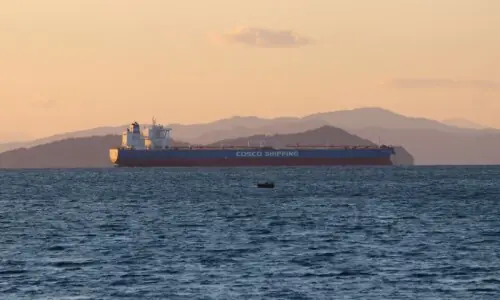
The Strait of Hormuz, a vital shipping route linking Middle East oil producers to markets in Asia, Europe, North America and beyond, has been at the heart of regional tensions for decades.
Iran has made threats to block the waterway in the past, without acting on them.The waterway separates Iran and Oman, linking the Gulf to the Gulf of Oman and Arabian Sea. The Strait is 21 miles (33 km) wide at its narrowest point, but the shipping lane is just two miles (three km) wide in either direction.
The US Energy Information Administration estimated that 18.5 million barrels per day (bpd) of seaborne oil passed through the waterway in 2016. That was about 30 percent of crude and other oil liquids traded by sea in 2016.
About 17.2 million bpd of crude and condensates were estimated to have been shipped through the Strait in 2017 and about 17.4 million bpd in the first half of 2018, according to oil analytics firm Vortexa.
With global oil consumption standing at about 100 million bpd, that means almost a fifth passes through the Strait.
Most crude exported from Saudi Arabia, Iran, the United Arab Emirates, Kuwait and Iraq — all members of the Organisation of the Petroleum Exporting Countries — is shipped through the waterway.
It is also the route used for nearly all the liquefied natural gas (LNG) produced by the world’s biggest LNG exporter, Qatar.
During the 1980-1988 Iran-Iraq war, the two sides sought to disrupt each other’s oil exports in what was known as the Tanker War.
Published in Dawn, April 24th, 2019