PM set to visit China for four days from 25th
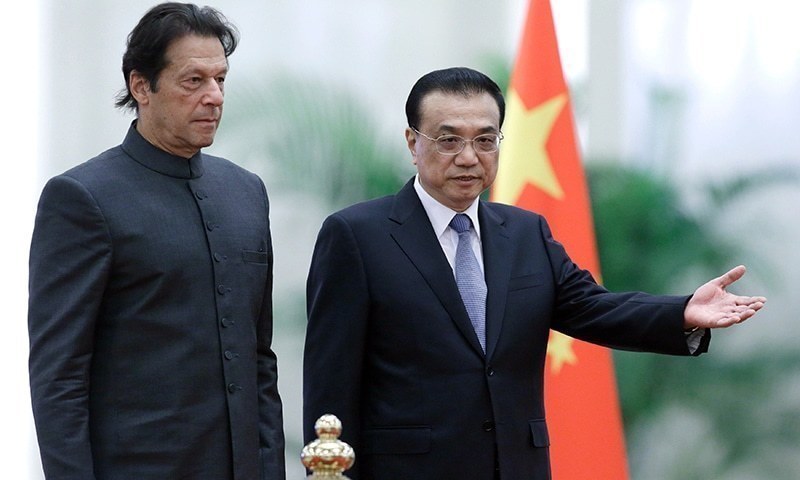

ISLAMABAD: Prime Minister Imran Khan will pay a four-day visit to China to attend the Belt and Road Forum and hold bilateral talks with the Chinese leadership on the new phase of the China-Pakistan Economic Corridor (CPEC) and other issues of mutual interest.
The Foreign Office, while announcing the prime minister’s visit, said Mr Khan would be “visiting China from April 25 to 28 to attend the 2nd Belt and Road Forum in Beijing”. He would also hold bilateral meetings with President Xi Jinping and Premier Li Keqiang and the two countries would sign several MoUs and agreements to enhance bilateral cooperation, it added.
Read more: Pakistan's debt policy has brought us to the brink. Another five years of the same is unsustainable
Chinese Ambassador to Pakistan Yao Jing, speaking at the launching ceremony of a book titled, “CPEC — A Precursor to Regional Economic Growth and Stability”, published by the Strategic Vision Institute (SVI), said: “Prime Minister (Imran Khan) is going to China next week and on that occasion, our leaders jointly working with him will elaborate the next stage of CPEC.” He said that the new stage of the CPEC was about broadening the area of cooperation under CPEC and it would have three pillars — the greater involvement of private sector; social sector cooperation; and the involvement of third party partners in CPEC projects.
Giving an overview of the progress on the setting up of special economic zones, the envoy said the zone in Rashakai (KP) had been finalised, documentation had been completed and groundwork had started. The two sides, he said, were working on other SEZs including one high-tech SEZ in Islamabad, involving some of the top Chinese tech companies, and one in Dhabeji (Sindh), which will have heavy industries. Chinese investors, he said, were signing up joint ventures with Pakistani firms in a local industrial zone in Faisalabad as well.
“All joint ventures and investments should be treated as CPEC priorities,” he said.
He said that an agreement on social sector cooperation in the fields of education, health, agriculture, irrigation, poverty alleviation, and human resource development would be signed during Mr Khan’s visit to China. A total of 27 social sector projects benefiting the common people, he said, were being started with the Chinese grant of $1 billion. The Chinese government, he said, would also give 20,000 scholarships to Pakistanis over the next couple of years.
Moreover, Ambassador Jing said that the two sides had agreed on involving the third party partners in CPEC projects.
“All countries are welcome to participate in Pakistan’s economic development,” he said, adding that CPEC projects “are inclusive, open, and all embracing”.
The envoy said that the Chinese government had full confidence in Pakistan’s future and its interest was China’s interest.
Speaking on the occasion, the chairman of Senate Standing Committee on Foreign Affairs, Senator Mushahid Hussain Syed, said that CPEC was a strategic national project, which was above party affiliations and provincial considerations. He said that the corridor was contributing to the strengthening of the federation by developing infrastructure and bringing progress and prosperity to the country.
He said “the best of CPEC” was yet to come, although the project had already made significant contributions in terms of addressing energy crisis, operationalising of the Gwadar port and activation of Thar Coal project.
Senator Mushahid said that Pakistan would become the hub of emerging ‘greater South Asia’, which he believed would not just include Saarc countries, but also China, Iran, and the Gulf region. He rejected threats of containing China saying it was an outdated cold war mindset, which was irrelevant to the 21st century Asia.
SVI President Dr Zafar Iqbal Cheema said that CPEC not only merits a more informed narrative, but based on the current government’s re-prioritisation of the goals of the project, there was a need for re-setting of the discourse on CPEC.
Published in Dawn, April 18th, 2019