THE Supreme Court today has a new chief justice and there is a fresh opportunity to turn the page on hyper judicial activism.
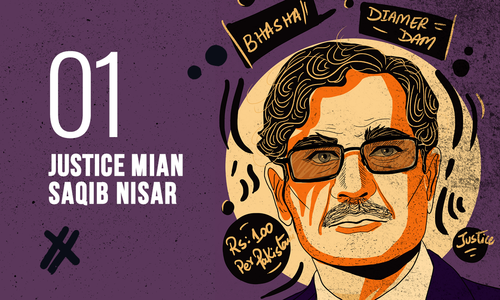
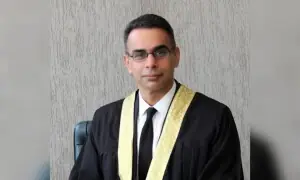
For the legacy of retired chief justice Saqib Nisar, who doffed his robes yesterday, can be encapsulated in one phrase: judicial overreach. And like many would-be saviours before him, his tenure has left institutions considerably weaker than they were when he arrived on the scene.
Populist grandstanding is inimical to systemic reform. In fact, Mr Nisar’s high-visibility forays into hospitals, filtration plants, prisons, etc, as a one-man vigilante squad and his public humiliation of elected officials and bureaucrats have injected a certain paralysis into public-sector functioning.
If anything, his interventions may have exacerbated institutional decay. Some of his actions bordered on the bizarre, eg ordering PIA not to change its livery or embarking on a fund-raising drive for the construction of the Diamer-Basha dam — even suggesting that due process could be avoided by litigants if they contributed to the dam fund.
One can concede that the former chief justice gave voice to public disillusionment with the state of governance by elected representatives, and raised the profile of some issues that deserve urgent attention, such as water scarcity and population control.
Read more: Judicial independence is vital for democracy but judicial activism can be counterproductive
However, in so doing, he recast his constitutional role to an unprecedented degree; an unelected individual wading into the political realm and intruding in the executive domain on the pretext of enforcing fundamental rights.
Meanwhile, he squandered the opportunity to overhaul a shambolic judicial system in which nearly 2m cases are currently pending. That would have done far more in the long run to ensure people’s rights than did his scattershot approach, exemplified by an unbridled use of suo motu powers by the apex court during the retired chief justice’s tenure.
A constitutionally mandated intervention reserved for the Supreme Court, which is indicative of its exceptional nature, Article 184(3) has certainly corrected some flagrant human rights abuses in the past.
In Mr Nisar’s hands, however, it introduced unpredictability and an unseemly ad hoc-ism into the judicial system. Consistency and the perception of the court as a neutral arbiter of the law enhance the perceived quality of justice, even as controversy degrades it.
But the winds may be shifting. Only a few days before Mr Nisar’s retirement, Supreme Court Justice Mansoor Ali Shah declared void the former chief justice’s order reconstituting a bench of the Peshawar judiciary in the middle of a hearing.
Yesterday, at the full court reference in honour of the outgoing judge, his successor, Justice Asif Saeed Khosa, who will be sworn in as chief justice today, said that suo motu notices would be taken “sparingly” and that he would like to “retire the debt of pending cases”.
One would certainly welcome a return to judicial restraint, and a start to the hard work — done quietly and determinedly — towards comprehensive judicial reform.
Published in Dawn, January 18th, 2019