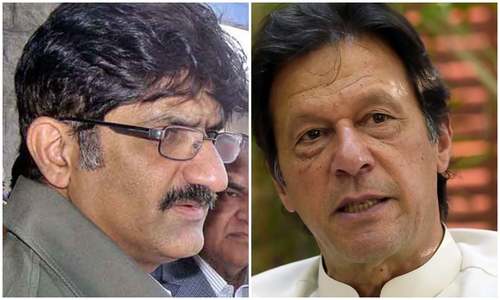
THE potential for a perceived partisan accountability process to escalate into a full-blown national political crisis has been vividly highlighted by competing statements from the PTI and PPP camps.
Seizing on the Supreme Court-ordered JIT report on the so-called fake accounts case and the inclusion of Sindh Chief Minister Murad Shah in the list of suspects in that case, the PTI federal government appeared enthusiastic to test the political waters in Sindh and perhaps try and dislodge the PPP provincial government.
The JIT report is incriminating but as the Supreme Court itself has clarified it is only a report at this stage — a long legal process lies ahead before the guilt or innocence of individuals implicated in the fake-accounts racket can be established.
An overenthusiastic and perhaps naïve PTI leadership appears to have mistakenly believed that political upheaval in Sindh was imminent.
To the PTI’s misbegotten abortive plan, the PPP has added its own attempt at muddying the political waters. Speaking to the media, Bilawal Bhutto-Zardari has claimed that if Asif Zardari signalled the willingness to do so, the PPP could oust the fragile PTI-led coalition at the centre.
Mr Bhutto-Zardari’s comments may be more bombast than a genuine threat, but they are an indication of the precariousness of the political landscape at the moment.
As the governing party at the centre and in two provinces with a share of government in a third province, the PTI must surely give greater consideration to the constitutional and political responsibilities that it now shoulders.
The willingness of the PTI to consider and put into motion a plan to oust a provincial government run by the third-largest political party in the country threatens to drag Pakistan politically backwards. The making and breaking of governments, potentially with the help of anti-democratic forces in the country, is a dangerous phenomenon that should have been left behind.
The PTI leadership may be in a hurry to deliver on Prime Minister Imran Khan’s promise to make the fight against corruption the core of his governance strategy, but meaningful and durable accountability are premised on fairness and due process.
Only recently, Mr Khan finally agreed to abide by the parliamentary norm of installing the leader of the opposition in the National Assembly as chairman of the Public Accounts Committee.
Shahbaz Sharif remains in NAB custody. So why must Chief Minister Shah resign or risk being pushed out by the PTI simply on the basis of a JIT report that has not been scrutinised by the courts or the accused?
The PTI has been unable to justify its stance either politically or legally. Where the PTI has erred, the PPP should avoid following suit.
Threatening to work to overthrow the federal government only lends credence to a perception that the PPP is opposed to any form of accountability.
Published in Dawn, January 2nd, 2019