IN Pakistan, even the dead wear handcuffs. It is to prevent an accused from escaping into eternity.
That might explain why the police found it necessary to leave the handcuffs on the corpse of Mian Javed Ahmed (the former CEO of Sargodha’s university campus in Lahore). Death was not a strong enough reason to remove them; the police needed a magistrate’s order first. Mian Javed Ahmed was no scholar. Had he been, he would have concurred with Aeschylus’ observation that “death is better, a milder fate than tyranny”.
Have we really sunk to this depth of civic depravity? How can we accept such desecration, and not react? But we have done, individually or collectively, and will continue to do so. We will sink even lower into a stygian darkness where we will no longer be able to discern the fine erasable line between civil rights and state wrongs, between the intoxicant of power and the delirium of tyranny.
More mature, experienced nations have left behind warnings for us: “Wherever Law ends, Tyranny begins”. And, as is our wont, we will ignore such advice, especially when it does not come attached with a promissory note for $9 billion to window-dress our Christmas time coffers.
There are some who wonder why the Saudis, the Chinese and the UAE have agreed to park $3bn apiece with our State Bank to shore up our crumbling reserves. Clearly, they have more confidence in the fiscal probity of the State Bank than the Pakistani public does.
Have we really sunk to this depth of civic depravity?
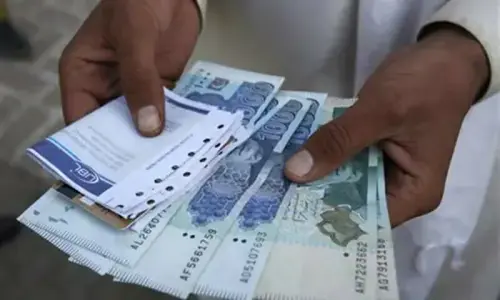
Those familiar with Pakistan’s banking system wonder how billions of rupees could be paid into benami accounts and then be transferred instantly to another account without a growl from the watchdogs of our economy. How could billions of rupees be withdrawn in cash (as the JIT report against the Zardaris reveals), when any cash withdrawal above Rs50,000 attracts tax and is brought to the attention of the bank’s operations department and (if the transaction is large enough) of the State Bank? How reliable is the State Bank’s computerised monitoring system when it can allow such elephantine transactions to vanish with impunity?
Just as Hitler did not run the crematoriums of Belsen and Auschwitz single-handedly, it would be naïve to suppose that the Zardaris and the Sharifs were able to manipulate the banking system without the connivance of pliable underlings. Many of them are still in office. Some have reappeared as part of the investigating team. They are the watchdogs who did not bark when they should have done. Today, they are ready to bite on command.
This year 2018 will end shortly, not a day too soon for the beleaguered Sharif brothers and the Zardari siblings. It has been a year of 365 traumas they would prefer to forget — if only their persecutors would let them. This paper ran a headline recently that described Nawaz Sharif’s ‘tryst’ with prison. ‘Tryst’, an odd word, used 71 years ago by another subcontinental prime minister. On midnight of 14th/15th August 1947, Jawaharlal Nehru spoke of India’s “tryst with destiny”. India and Pakistan have come a long way since then in the treatment of their prime ministers.
Today, the Pakistani public like Roman spectators in the Coliseum is being distracted daily by the spectacle of a former president and a former prime minister being pilloried by obsequiously obedient former subordinates. If any of them has the time, they should read a novel published in June 1949, two years after our independence. It foretold a world as it might exist 35 years later, in 1984.
Next year, 2019, it will be 35 years since the 1984 that George Orwell wrote of, that dark, prescient warning against the dangers of totalitarianism. He introduced terms like ‘Newspeak’ and ‘Unperson’ (someone ‘vapourised’, not only killed by the state, but erased from existence), and ‘Doublethink’ — “the power of holding two contradictory beliefs in one’s mind simultaneously, and accepting both of them”.
George Orwell wrote Nineteen Eighty-Four soon after the end of the Third Reich. He lived to see Stalin’s ruthless regime. His pen serves as a telescope for us: “The German Nazis and the Russian Communists ... pretended, perhaps they even believed, that they had seized power unwillingly and for a limited time, and that just around the corner there lay a paradise where human beings would be free and equal. We are not like that. We know that no one ever seizes power with the intention of relinquishing it. Power is not a means; it is an end. One does not establish a dictatorship in order to safeguard a revolution; one makes the revolution in order to establish the dictatorship.”
The Albanian poet Visar Zhiti used fewer words as an epitaph for the likes of Mian Javed Ahmed: “Handcuffs weigh much more than gravestones.”
The writer is an author.
Published in Dawn, December 27th, 2018